
An obsolete catalogue site rebuilt as a product and specification system.
How Jardine Studio rebuilt Lambert’s catalogue-led website into a 13-page product and specification system for architects, lighting designers, and specifiers.
PROOF SO FAR
Launch and implementation facts from the completed Lambert engagement. These figures do not claim traffic, inquiry, ranking, conversion, or revenue improvement.
Visit the live site(opens in a new tab)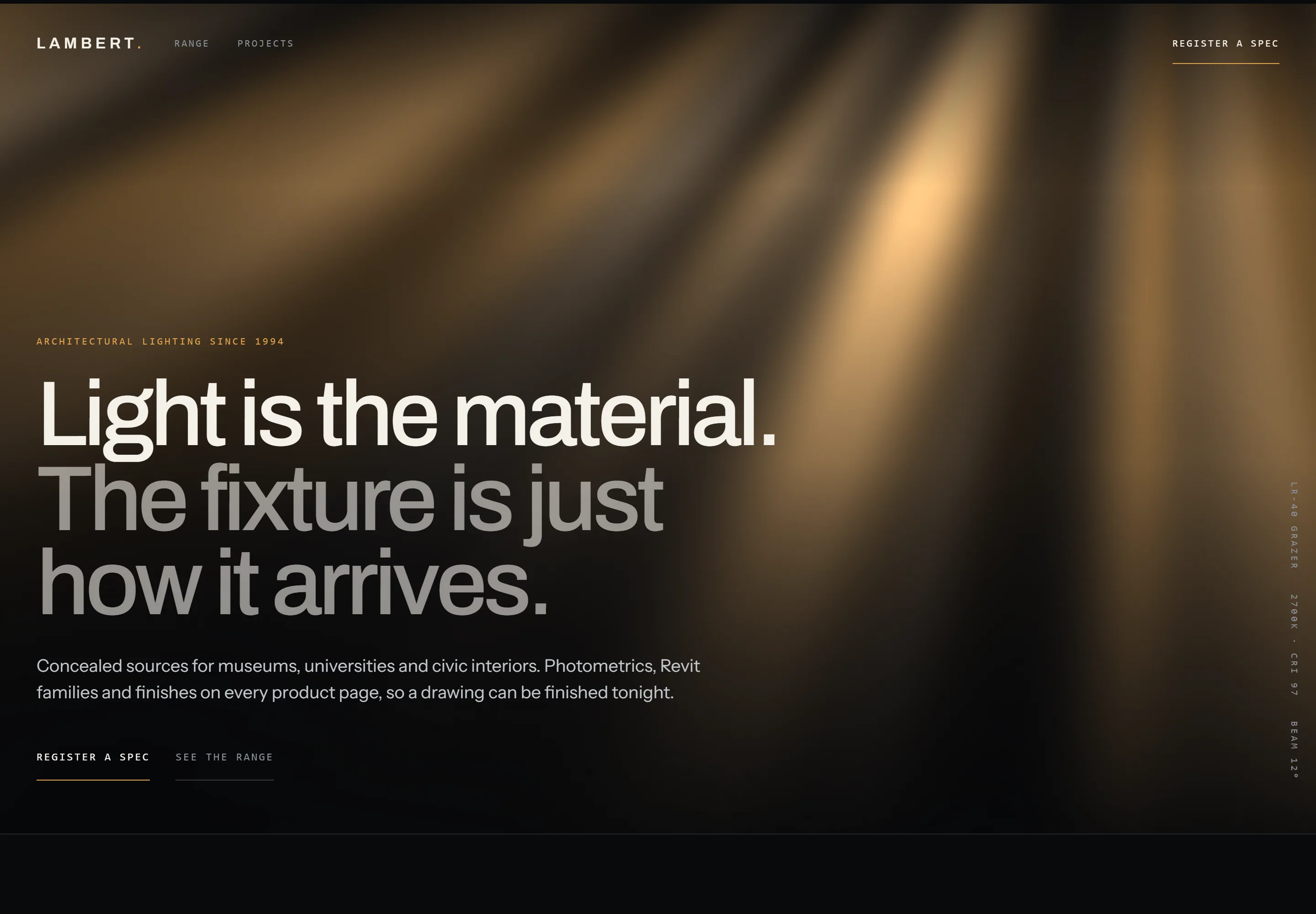
The situation
Lambert is an architectural-lighting manufacturer in Rhode Island, USA. Its former website presented a design-sensitive, technical product through an obsolete catalogue-first experience. Product discovery was shallow, mobile use was limited, and too much critical information lived inside a 46 MB PDF instead of on pages a professional buyer could inspect, share, and return to.
The problem was larger than visual age. Architects, lighting designers, and specifiers needed to move from the type of space they were lighting to a viable product family, understand the configuration, review technical information, and request the relevant files. The old structure made that buying and specification job harder than it needed to be.
| Project fact | Detail |
|---|---|
| Business | Lambert Architectural Lighting |
| Market | Rhode Island, USA |
| Audience | Architects, lighting designers, and specifiers |
| Scope | Positioning, information architecture, identity refinement, visual direction, copy structure, SEO continuity, implementation, deployment, and QA |
| Delivery | Approximately three to four weeks |
The architecture
Jardine extracted and reorganized the catalogue source material into a system built around professional intent. Five application-led product families help buyers begin with what they are trying to light. Seven configurations provide the next level of product choice. Specification data, file requests, and project evidence stay close to the relevant product instead of being separated into a document warehouse.
Map the catalogue around applications
The product model begins with five application-led families rather than asking a buyer to decode a warehouse of category names. Each family creates a clearer path from the lighting problem to the products that can address it.
Retain the language existing buyers know
All fourteen legacy product-category terms and the four established route concepts were retained in the new architecture. The experience changed without discarding the vocabulary and paths that customers, links, and search engines could already recognize.
Put specification support beside the product
Product pages bring technical specifications and file actions into the same decision surface. Buyers can assess a configuration and enter a product-aware specification request path without returning to a detached catalogue.
Add project evidence without hiding the catalogue
Three project pages show the lighting in context while the product-family routes remain the main working layer. The evidence supports the specification job instead of turning the site into a portfolio with no technical depth.
Build and validate one maintainable system
The completed site is generated as a static system with responsive media, canonical metadata, structured data, and build checks across all thirteen production pages. The same source model can be maintained without hand-building every route.
Inspect the rebuilt interface
The interactive preview below shows the rebuilt Lambert site and a labelled desktop and mobile comparison. The former site shown in the comparison is Jardine Studio's reconstruction from the available legacy experience. It is included to explain the structural and visual change, not presented as an archived capture of the original production site.
Decisions that mattered
Decision 01. Organize around what the buyer is trying to light.
The new product families start with application rather than internal catalogue logic. That reduces the translation work for a professional buyer and makes the first route choice meaningful before they know Lambert's complete product vocabulary.
Decision 02. Preserve continuity while changing the hierarchy.
A rebuild should not erase every known term simply because the interface changes. The fourteen legacy category terms and four established route concepts were retained within the new model. That protected continuity for existing buyers and gave the migration a defensible relationship to the former site.
Decision 03. Keep technical information close to the decision.
The catalogue had forced too much product evaluation into a large PDF. The rebuilt pages place specifications and file actions beside each configuration, so the website can support serious review rather than stopping at an image and a short marketing paragraph.
Decision 04. Use art direction to communicate quality, not obstruct the task.
Architectural lighting is judged visually, so the site needed stronger visual direction. Light-based interaction, motion, and project imagery communicate the character of the product while navigation, product labels, specification data, and actions remain legible and direct. Reduced-motion and touch experiences keep the same information without depending on the effect.
Decision 05. Refine the identity instead of claiming a full rebrand.
The engagement refined Lambert's established logo and identity for digital use. Type, spacing, colour, image treatment, and interface details were brought into a coherent web system without presenting the work as a wholesale replacement of the company brand.
Decision 06. Generate and validate the production system.
Thirteen pages, multiple product families, configurations, project evidence, metadata, and responsive assets create room for inconsistency if they are managed as isolated files. The static generation and validation workflow made the structure repeatable and checked the complete release as one system.
What changed
The completed engagement produced thirteen responsive production pages, five product-family routes, seven configurations, three project pages, on-page specification support, structured data, canonical metadata, responsive media, and a deployed production website. Jardine owned the work from positioning and information architecture through identity refinement, copy structure, visual direction, implementation, deployment, and QA.
These are launch facts, not growth outcomes. The case does not claim improved traffic, inquiries, rankings, conversion, or revenue. Its evidence is the shipped system, the retained catalogue continuity, and the decisions visible in the live product experience.
What this case proves
Lambert shows how Jardine can translate a complicated technical catalogue into a credible B2B buying and specification experience. The work joins B2B website strategy, web design, custom development, and SEO migration discipline around the same professional task instead of treating each as a separate handoff.
Inspect the live Lambert website or discuss a B2B product, catalogue, or specification system.