

How much does website design cost in Toronto?
Compare Toronto website design and development scopes in CAD, with real GTA project examples and a practical guide to evaluating proposals.
A focused website at Jardine Studio starts at CAD 1,900 before tax, with supplied content, a clear service structure and a straightforward inquiry path. That is a Toronto studio's starting scope, not an average for the Toronto market. A useful comparison asks what each proposal includes and who will deliver it.
The examples below draw on two different local projects: B&B Specialty Contractors in the GTA and The Black Salt Room, a Toronto wellness practice. They show how page structure, design and inquiry requirements shape the work. Pricing on this page is in CAD; project examples describe delivered scope, not historical invoices.
What different website budgets buy
Jardine's focused starting scope is CAD 1,900 before tax for a compact service site with supplied content and a straightforward inquiry path. A limited brand-led subset of core offering pages, using a shared template, can fall within CAD 1,900–3,100 before tax. Additional media work can take that subset toward CAD 4,000. The range does not cover every page or feature in the full Black Salt Room website.
The lower figure assumes a compact structure and a clear path to inquiry. More individual layouts, original content, video preparation, integrations or migration create additional work. A larger website or a bespoke business system needs its own scope rather than an extrapolation from the starting price.
These examples describe design and implementation depth. The website cost calculator also uses CAD before tax, combining page buckets and selected feature allowances. Its result can differ because it makes different assumptions. Neither method replaces a written proposal specifying the pages, unique layouts, media, functionality, currency and exclusions.
This guide uses CAD throughout. The general custom website cost guide uses studio USD prices; Canadian prices are 1.25 times those figures, which is below the exchange rate. Confirm CAD explicitly when comparing proposals.
Two local businesses, two different website scopes
B&B needs homeowners to understand several trades and ask for an estimate. Black Salt Room needs visitors to understand individual sessions and begin a personal conversation. Both are service businesses, but their websites organize the information and the inquiry differently. Those differences are more useful for budgeting than treating every service website as the same product.
B&B Specialty Contractors: make the work and service area clear
B&B's GTA contractor website has three main public pages: home, services and estimate. Six service groups share one services page, with homepage links taking visitors to the relevant section. That concentrates the content instead of requiring a separate page design for every trade.
The estimate page leads to an email to the business. It gives a prospective customer a route to describe the job before arranging the next conversation. It should be priced as that actual contact path, not as an automated quoting system or a complex intake form.
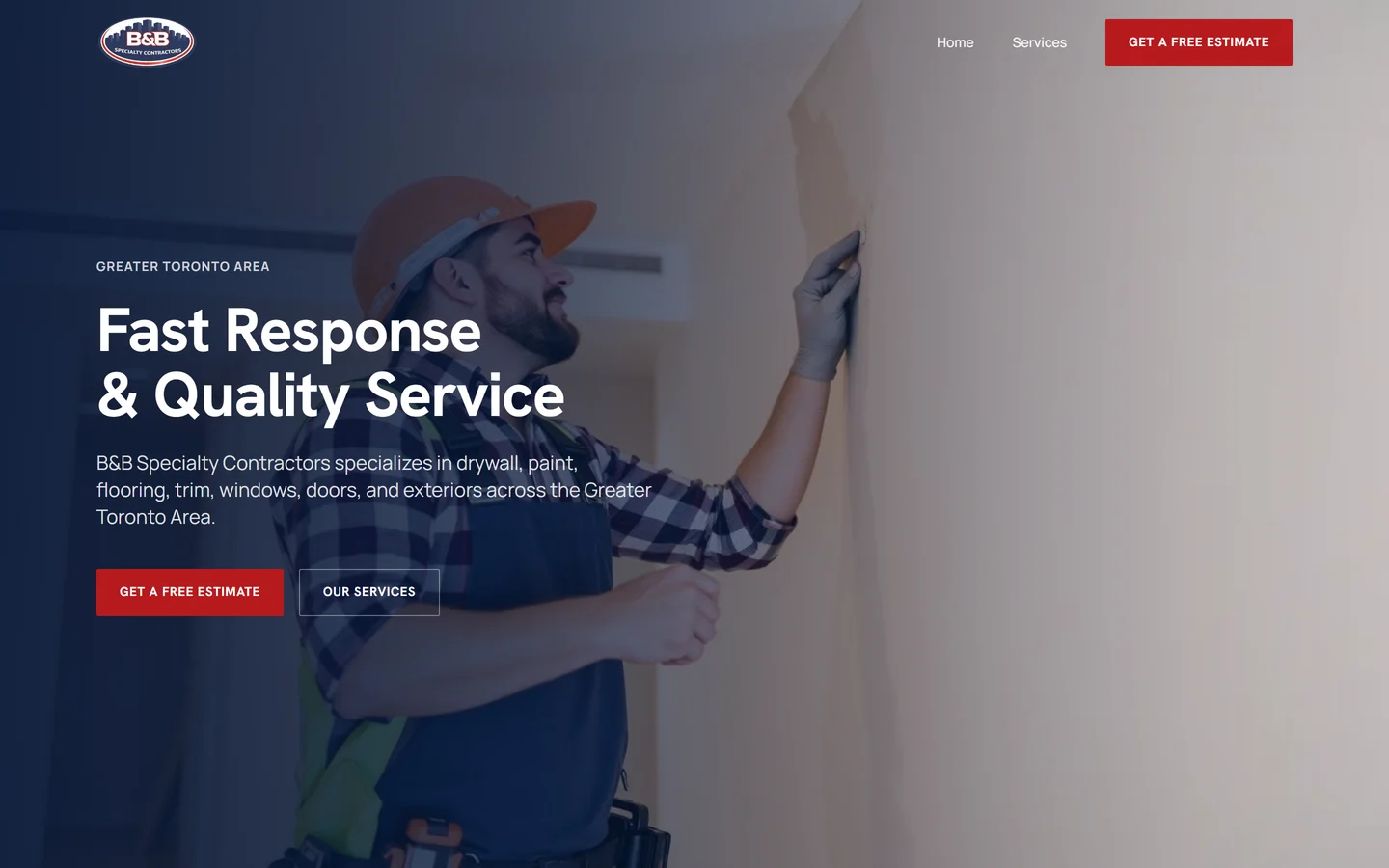
For a comparable project, establish whether the service descriptions and imagery are ready, whether one shared service page is sufficient, and whether email meets the inquiry requirement. If the business needs separate location pages, original photography or structured job intake, those are additional requirements to name in the brief.
Black Salt Room: explain the offering before the inquiry
The Black Salt Room website gives breathwork, yin yoga, restorative yoga, meditation and seasonal circles their own offering pages. These share a page structure, alongside supporting pages elsewhere in the site. Five offerings should not be mistaken for the website's total page count or five entirely unrelated page designs.
Links from offering pages carry the visitor's interest into the inquiry form. That gives the owner context for a reply. It is a personal inquiry flow, not automated session booking, availability management or payment collection.
The site also uses video on desktop and a still image on phones. A similar brief needs to account for media preparation, responsive delivery and testing, as well as the visual direction. The relevant purchasing question is whether those tasks are included in the quoted design and build.
The CAD 1,900–3,100 range above covers a limited subset of core offering pages with a shared template, informed by this project. It is not a price to reproduce the full current Black Salt Room website. Supporting pages, additional content, media preparation and form behavior must be listed and priced in the written scope.
Separate design from development in the proposal
Design defines how the website communicates and how visitors move through it. Development implements the pages, interactions and connected services. A proposal can bundle both, but it should still explain the deliverables. Design-only work needs a clear handoff; a combined quote needs clarity about content, implementation, testing and launch responsibility.
For a B&B-like brief, the design includes organizing several services and making the estimate action easy to find. Implementation includes the responsive layouts, navigation and email route. For a Black Salt Room-like brief, the offering template, interest-prefilled form and media delivery introduce different implementation tasks.
Ask whether “website design” means approved design files or a working, launched website. If another developer will implement the designs, establish who checks that the finished result matches them and who handles issues between the two stages.
Platform selection is a separate decision. WordPress can use a custom theme, and a custom frontend can connect to a CMS. The custom website cost guide explains that distinction; the CMS comparison covers the editing decision in detail.
Compare freelancers, small studios and agencies by responsibility
A provider's size does not tell you whether its proposal fits the project. Compare who designs, builds, writes, reviews and supports the website, and whether that team can cover the required work and schedule. Ask how changes and absences are handled. Those answers are more useful than assuming one provider type must always be cheaper or better.
Freelancer
- Establish
- Which disciplines the individual delivers and which require outside help.
- Ask
- Who handles specialist work, availability gaps and support after launch?
- Compare
- The actual deliverables, review process and ongoing responsibilities.
Small studio
- Establish
- Who is hands-on, who makes decisions and whether any work is subcontracted.
- Ask
- How many people need to approve work, and who coordinates design and development?
- Compare
- The actual deliverables, review process and ongoing responsibilities.
Larger agency
- Establish
- The team assigned to this engagement and the role of each specialist.
- Ask
- Which strategy, content, research or account-management services are included?
- Compare
- The actual deliverables, review process and ongoing responsibilities.
For local work, specify whether meetings, photography or on-site activity are required. A Toronto address alone does not establish the delivery process or justify a price premium. Jardine's Toronto studio page is the place to evaluate the studio's work and approach.
How to compare two website proposals
Give both providers the same requirements, then compare their inclusions before their totals. Identify who supplies the content, how many distinct layouts are included, what the inquiry must do and which recurring services are required. Two different prices can both be reasonable if they purchase different work. The comparison should make that difference visible.
Consider a separate illustrative GTA contractor project: introduce the business, explain the services and let a homeowner request an estimate. This example uses a compact page structure and a standard form; B&B's actual email inquiry route is described above.
Focused launch
- Content
- Owner supplies approved text and usable images.
- Structure
- Home, one services page and an estimate page.
- Inquiry
- Standard inquiry form to an agreed recipient, with manual owner follow-up.
- Additional responsibility
- Owner prepares content and handles incoming inquiries manually.
Expanded brief
- Content
- Provider interviews the owner and writes service copy; photography is separately defined.
- Structure
- Dedicated service pages using agreed reusable layouts.
- Inquiry
- Structured form with specified fields, validation and delivery behavior.
- Additional responsibility
- Provider handles more content and implementation; owner still approves the material and follows up.
The expanded brief adds work. It does not automatically produce more inquiries, and it is not necessarily the better first release. Ask which requirements serve the business now and which can wait.
Price the compact launch, then mark optional work
For this example, the launch has Home, Services and Estimate, supplied copy and images, ordinary CMS fields and the standard inquiry form. The owner answers inquiries manually. This is an illustrative web design and build scope.
Illustrative compact launch range: CAD $1,900–$2,500 before tax.
- Reproduce the inputs: select CAD, New site and 1 to 3 pages. Keep the standard form, add nothing and leave timing at To discuss. Ordinary CMS setup is included.
- One-time responsibilities: the studio implements the agreed pages, editing fields and inquiry path. The owner supplies approved service descriptions, service-area details and usable images, provides account access and names the inquiry recipient.
- Ongoing responsibilities: the owner follows up, updates services and controls the domain and provider accounts. Hosting, renewals, subscriptions and any care agreement are separate from the build range.
- Example acceptance checks: confirm a homeowner can find the offered trade and service area on a phone; edit a description through the CMS; check keyboard navigation, required-field errors and receipt of an agreed test inquiry. Confirm the failure and recovery path in the proposal. These are suggested checks, not measured client results.
Owner interviews, original writing, photography and dedicated service-page layouts remain separately scoped. If structured intake requires branching questions, uploads or processing beyond the standard form, mark that workflow for discovery rather than assigning it an automatic add-on price.
Illustrative partial range with custom intake excluded: CAD $1,900–$2,500 before tax.
This is not the complete project price. Discovery work is excluded. The final price will be higher or otherwise adjusted once that work is scoped.
To reproduce the optional variant, keep the compact CAD selections and open Migration, intake and timing. Select Custom intake or form workflow. The base range remains visible while the intake implementation is unpriced. It also excludes original content and additional layouts; if dedicated service pages increase the page count, update the page bucket before comparing proposals. Use web development to define intake fields, validation, delivery and failure handling before accepting the expanded brief.
Normalize the brief.
Give each provider the same required pages, content status, integrations, approval process and launch constraints.
Mark every exclusion.
Check copywriting, photography, content entry, redirects, forms, software, training and post-launch support.
Separate the costs.
Confirm CAD, tax treatment, one-time work, recurring charges, payment milestones and the process for extra scope.
Resolve the differences.
Ask each provider to explain missing deliverables and alternatives before choosing on the headline price.
If this replaces a working website, include the existing URLs, content and integrations in the brief. The redesign versus rebuild guide helps identify what needs changing before a provider prices the transition.
BDC's agency-selection guidance recommends evaluating technical capability, fee structure and the owner's time commitment. The example makes those responsibilities explicit; BDC does not establish these Jardine prices.
Check what you will own and pay for after launch
Ask for a separate list of domain, hosting, platform, app and maintenance costs, with their billing currency and renewal terms. Confirm who controls the accounts and how content changes are handled. A build quote and a monthly service can cover different responsibilities; compare those responsibilities before comparing their first-year totals.
A useful handover identifies access, editing instructions, support arrangements and the source files or assets included under the agreement. Ask what happens if you later move providers, and which licences or subscriptions must continue for the website to work.
Content and service changes need an owner too. For a contractor, that could mean updating offered trades or service areas. For a wellness practice, it could mean revising session details. Specify who makes those changes, whether a CMS is required and whether training is included. Do not buy an editing system merely because it appears in a package.
Get a planning estimate for your own project
The calculator links on this page open a CAD estimate before tax. Requirements needing discovery appear separately from the priced scope, so a partial estimate is not the total project price. Confirm the final deliverables in the written quote, and compare proposals in the same currency.
The calculator's migration allowance covers planning only. Redirect implementation, content moves and platform migration work are separate. Defined standard ecommerce and membership implementations on established platforms can use their planning allowances. Bespoke commerce, complex membership systems, AI workflows, location-page packages and other undefined functionality require discovery. Hosting, licences, subscriptions, transaction fees and ongoing support need a separate recurring budget.
Open the website cost calculator
, or send the studio your project requirements. Include your current site, the pages and systems that must be retained, what content is ready, your CAD budget and the date that matters. Jardine's pricing approach explains how the engagement is scoped.
Sources and pricing basis
Reviewed September 30, 2026. Prices are Jardine Studio planning examples in CAD before tax, based on defined scope assumptions. They are not a representative survey of Toronto suppliers or historical client invoices. The compact contractor range and optional intake preset use the calculator's current model. B&B and Black Salt Room support the delivered scope described in the project sections; they do not establish the hypothetical contractor form implementation. The proposal comparison and acceptance checks are illustrative guidance.
References (4)
- Jardine Studio. Pricing and engagement approach. https://jardinestudio.com/pricing
- Jardine Studio. B&B Specialty Contractors case study. https://jardinestudio.com/work/bb-specialty-contractors
- Jardine Studio. The Black Salt Room case study. https://jardinestudio.com/work/black-salt-room
- BDC. Choosing the right agency to build your website. https://www.bdc.ca/en/articles-tools/technology/create-website/choosing-right-agency-build-your-website
Bring the project into focus.
Tell us what your Toronto or GTA business needs from its website. Include the current site, required pages and integrations, content readiness, CAD budget and launch date.