
A technical SEO audit that tells you what to fix first.
You get the fixes in the order they matter, not a long issue list to decode.
Who is this audit for?
The Technical SEO and AI search readiness audit checks your website's technical health and whether search engines and AI assistants can reach it. Then it ranks what to fix first.
It's for small business sites, and for agencies that want a white label check of a client site.
- Owners who want to know whether the site has problems before paying for more SEO, ads or a redesign.
- Businesses that just went live, moved platforms or redesigned, and want to know nothing broke. If the move is still ahead of you, SEO migration is the better fit.
- Teams asking "are we ready for AI search?" who want a straight answer.
Trying to decide between an audit and ongoing work? SEO audit, focused project or ongoing SEO: choose the engagement walks through the choice. For the ongoing side, see SEO services.
One fixed price, set by site size
CAD 800 / USD 750. Small sites (up to about 25 pages): CAD 450 / USD 400.
That covers the whole audit, the report and the call.
The full fee is paid before work starts. If you book the fixes with Jardine Studio within 30 days of delivery, the full audit fee is credited.
What will you walk away with?
You get a plain-language report covering what's working, what to fix, why it matters and roughly how long each fix takes. If your site is in good shape, the report says so.
| What you get | What it tells you |
|---|---|
| A ranked fix list | Each item lists the pages affected, the evidence, the impact, the effort, the fix and how to check it. Your developer or agency can work straight from it. |
| A repair or rebuild verdict | Whether the site needs small, contained fixes or a bigger change. |
| A crawl and indexing check | Whether search engines can find your pages and, with Search Console access, whether Google has indexed them. |
| A rendered page review | Whether each page shows what it should once it loads, on phone and desktop. |
| AI search readiness | Which search and AI crawlers your robots.txt lets in, how your structured data holds up, and what Google says actually matters. |
| A walk through your site as a buyer | Whether someone shopping for what you sell can find you, decide you're right and get in touch. |
| A Search Console and GA4 review | What Google and your analytics show, if you give read access. |
| A 30 minute call | We go through the report together, and you decide what to fix first. |
We check your site against Google's own documentation: Google Search Essentials (opens in a new tab) and Core Web Vitals (opens in a new tab).
How is this different from the free check?
The free check is a good place to start. This audit is the same questions, answered by a person, with a fix plan and a call.
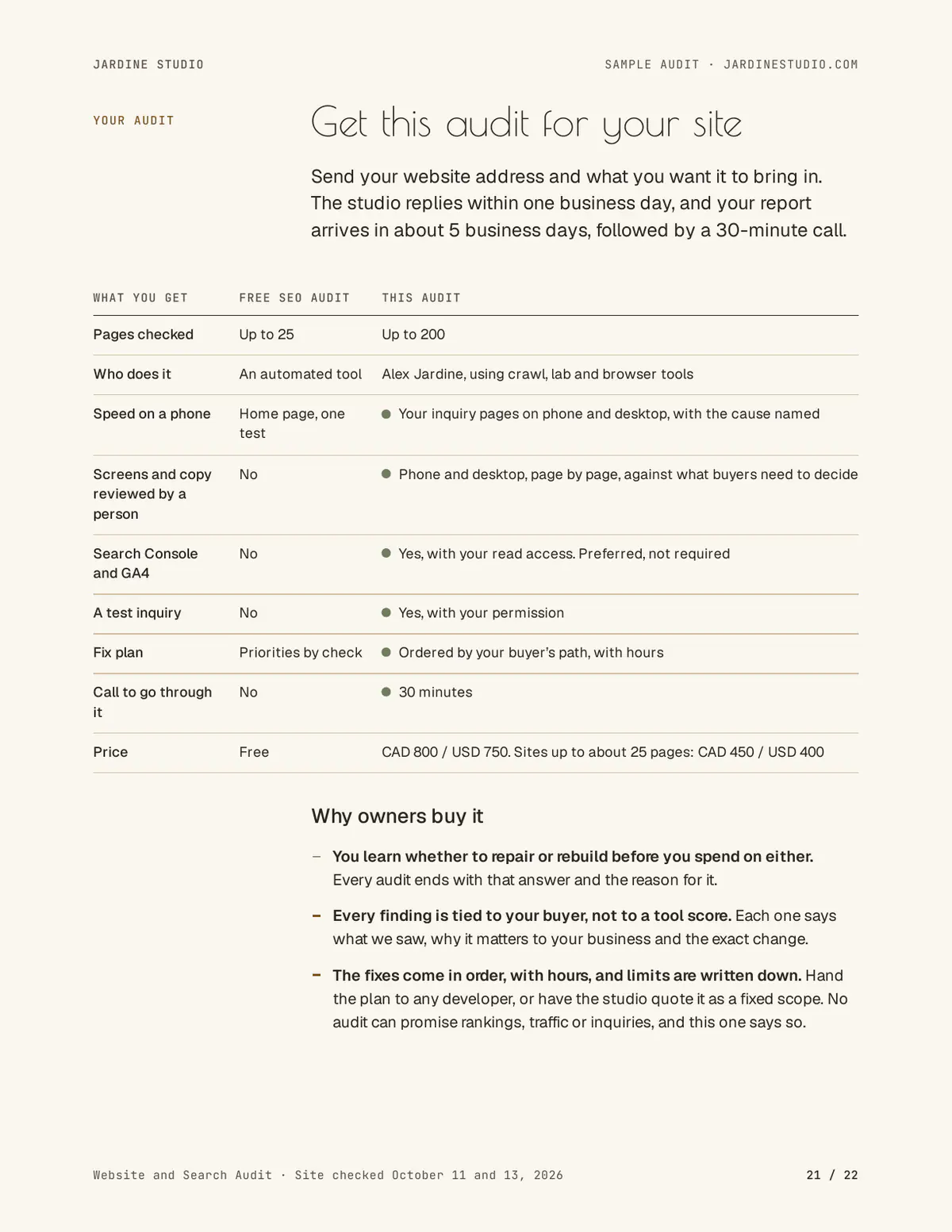
| What is compared | Free SEO audit | This audit |
|---|---|---|
| Pages checked | Up to 25 | Up to 200 |
| Who does it | An automated tool | Alex Jardine, using crawl, lab and browser tools |
| Speed on a phone | Home page, one test | Your inquiry pages on phone and desktop, with the cause named |
| Screens and copy reviewed by a person | No | Phone and desktop, page by page, against what buyers need to decide |
| Search Console and GA4 | No | Yes, with your read access. Preferred, not required |
| A test inquiry | No | Yes, with your permission |
| Fix plan | Priorities by check | Ordered by your buyer's path, with hours |
| Call to go through it | No | 30 minutes |
| Price | Free | CAD 800 / USD 750. Sites up to about 25 pages: CAD 450 / USD 400. |
Want the fixes to stay fixed?
Standard care, CAD 200 / USD 200 a month, including about 2 hours of fix time, billed monthly with no contract, cancel any time.
Your report in about 5 business days
The report and fix list arrive in about 5 business days, counted from when we have your URL and any access you're sharing.
How does the audit work?
Send the URL, then the audit, the report and the call. Fixes after that are your choice.
- 01
Your URL and access.
Send the site address. If you'd like Search Console and GA4 reviewed, add read access to both.
- 02
The audit.
We crawl your public pages, check what Google has indexed, review rendered pages and walk the site the way a buyer would.
- 03
The report and call.
You get the report and ranked fix list, then we go through it together on a 30 minute call.
- 04
Fixes, if you want them.
You decide what to fix and who fixes it. The studio can make the fixes, or your team can. Fixes are quoted separately.
What happens after the audit?
You decide what to fix and who fixes it. The report is yours, and the studio can quote the work or leave it with your developer.
- Your own developer. Every fix names the page, the evidence and the change, so your developer or agency can work from the plan directly.
- The studio makes the fixes. We quote the plan as a fixed scope after the call, so you know the cost before work starts. If you go ahead within 30 days, the audit fee comes off that invoice.
- Someone keeps watch. Once the fixes are done, you can add Standard care. It is billed monthly, with no contract, and you can cancel any time.
Want to see a real report first?
This 22-page sample is the same audit, run on our own site.
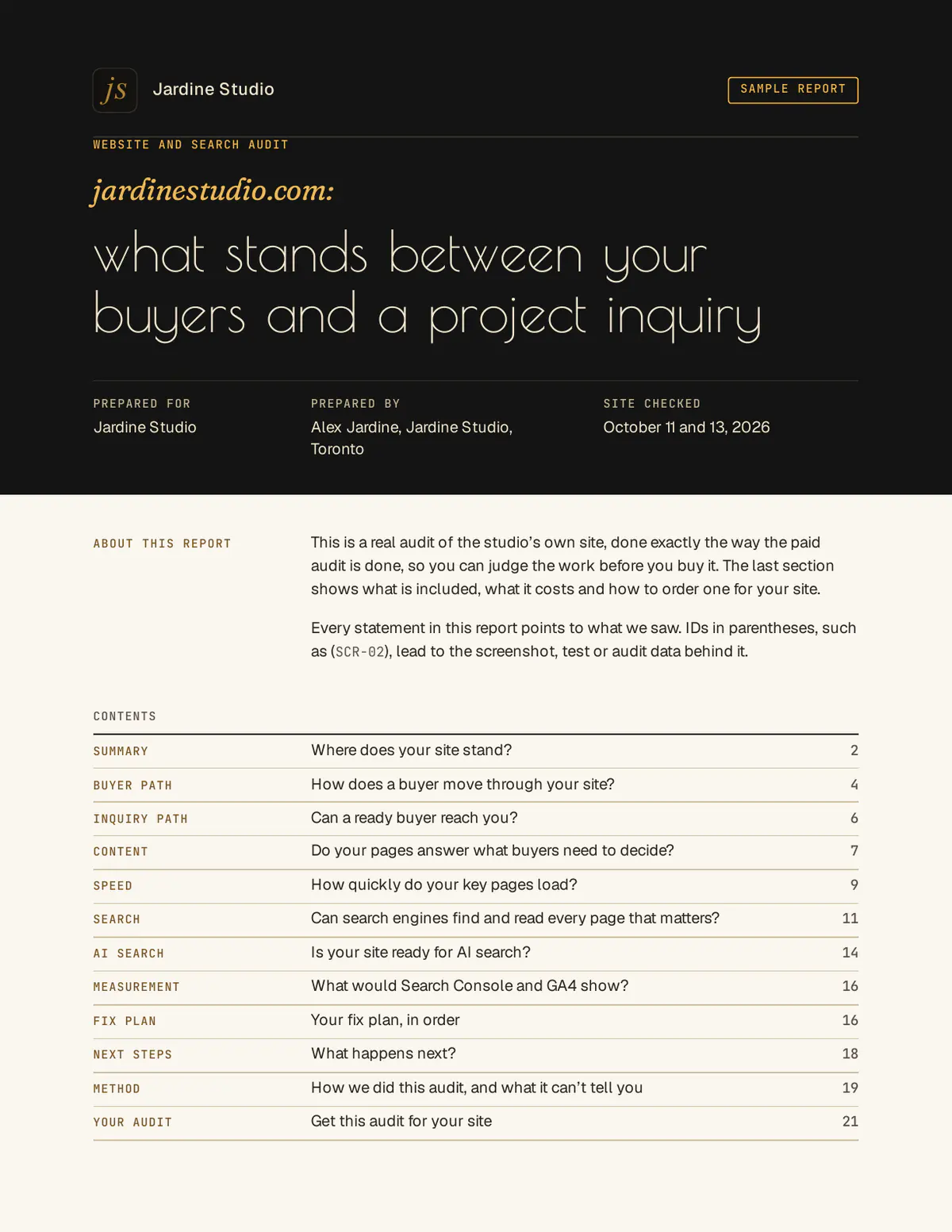
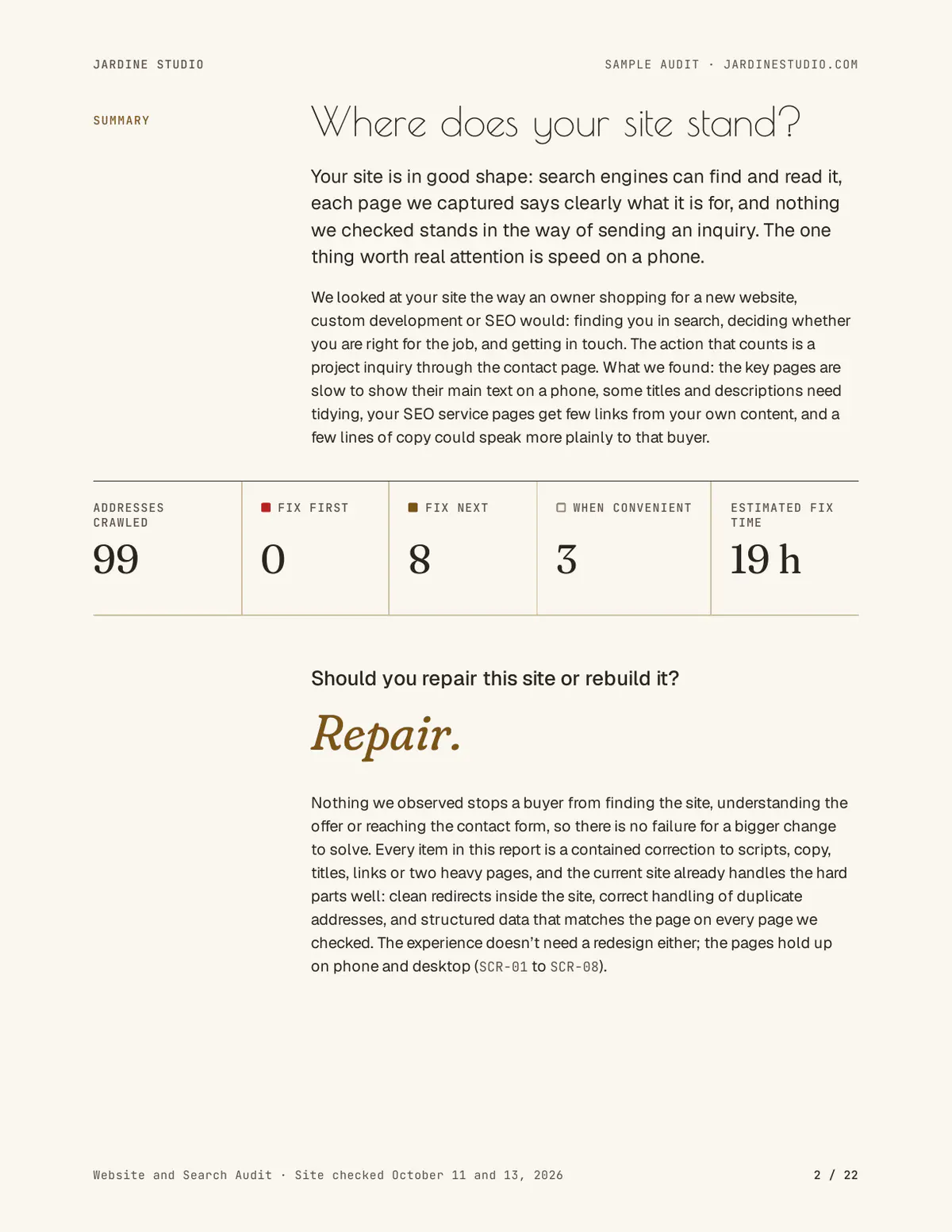
See the 22-page sample (1.0 MB, PDF) (opens in a new tab)
What did our own audit find?
We ran the same audit on our own site. The verdict was Repair. Phone speed needed the most attention, then links from our own content to the SEO pages, a few lines of copy, and titles. Redirects inside the site were clean. The fix plan was about 19 hours.
Is a clean crawl the same as indexed?
A clean crawl isn't the same as indexed. The same week our crawl came back clean, Search Console's URL Inspection showed a new service page as "unknown to Google" and two others as "crawled, currently not indexed."
A crawl shows whether your pages can be found and read. Only Google can say whether it has indexed them. That's why the audit checks indexing as well as the crawl, using Search Console when you share access.
What do owners ask before booking?
Price, timing, the small-site tier, the fee credit, access, rankings, who makes the fixes, AI search, and how this differs from the free check.
What does it cost?
How long does the audit take?
What access do you need?
What does a small site cost?
Will this improve my rankings?
How does the fee credit work?
Can you fix what you find?
Does it cover AI search?
How is it different from the free check?
Related services and reading.
Local SEO and the choice between an audit and ongoing SEO sit next to this offer.
Ready to see what to fix first?
Send us your URL. Your report and ranked fix list arrive in about 5 business days.