

Why your website is not getting leads
Diagnose why your site is not producing calls or inquiries by separating traffic problems, trust problems, and broken contact paths.
Most articles on this topic give the reader ten generic causes and call it diagnosis. It is not. A website that is not producing leads is usually failing at one of three specific jobs, and the fix for one can be wasted money on the others. Before changing anything, the owner needs to know which problem is actually theirs.
A site that should be producing leads and is not is usually failing in one of three ways. The right buyers are not arriving. They arrive, but the page does not earn enough trust. Or the contact path breaks before they act. Spending on a redesign, SEO, or paid ads before naming the bottleneck often means spending on the wrong fix. This page walks through the three, then shows how to tell which is most likely in about ten minutes.
Before any of the fixes that follow, the free Website Audit gives a page-level read on website health, SEO, and AI visibility.
The first fork: are people actually arriving?
The first question to answer is the simplest one. Open Google Analytics and look at the last 30 days of sessions. If the site is getting very little traffic, the problem is usually visibility. Redesign or copy work alone will not create demand, with one real exception: if the old site is blocking search engines, loading badly, or failing on mobile, a rebuild can be part of the visibility fix. If the site is getting meaningful traffic and still producing no leads, traffic may not be the bottleneck. More SEO will not fix a page that already gets buyers but fails to earn the next step.
Your site is not getting leads
No traffic
The right buyers are not arriving. Visibility is the bottleneck: indexing, SEO foundation, Google Business Profile, intent, or distribution beyond search.
Post-click trust
They arrive, but the page does not earn the next step. Audience clarity, message specificity, trust signals, speed, or an unanswered buyer objection.
Broken contact path
They want to inquire and cannot, or the friction is too high. CTA placement, form length, fallback paths, click-to-call, or a broken booking link.
That distinction matters because the wrong branch leads to the wrong fix. From here, the page handles the traffic problem and the post-click problems separately. From here, the page handles the two branches separately.
If the right buyers are not arriving (Fork A)
These causes explain most traffic shortfalls. The site is not indexed, the SEO basics are weak, the business is missing or thin on Google Business Profile, the right service or location pages do not exist, the targeted queries have little buyer intent, or there is no distribution beyond search. A newer one belongs on the list too: buyers increasingly ask ChatGPT, Perplexity, and Google AI Overviews before they open a search tab, and a site the engines cannot extract or cite stays invisible in those answers. Getting cited in AI search is its own layer of visibility work. Each one has a different fix and a different cost. The free Website Audit can flag page-level issues; the Strategic Website Audit can turn the wider context into a prioritized fix plan.
The site is not indexed, or is accidentally blocked
A common cause owners miss. A new site, a botched migration, an active noindex tag, or a robots.txt that blocks crawlers will all keep the site out of Google entirely. The check is one minute: search Google for site:yourdomain.com and see how many pages come back. Zero or near-zero means the site is not in the index.
There is no real SEO foundation
The pages are not built around the queries buyers actually search. Titles are generic, headings do not target anything, service pages do not exist for the services being sold. A site can be beautiful and rank for nothing. The studio's SEO and growth work is built around fixing this gap: technical foundation, content structure, local visibility, and the search intent behind the pages.
The business is missing or weak on Google Business Profile
For many local or service-area businesses, Google Business Profile can influence inquiries before the website is ever loaded. A missing profile, an unclaimed profile, weak categories, thin services, outdated photos, or few recent reviews can quietly limit local visibility.
The right service or location pages do not exist
The site has a single "Services" page when it sells five distinct services, or one homepage when it serves three cities. A buyer searching for the specific thing or the specific place lands on a competitor's page that did the work.
The targeted queries have no buyer intent
The site may rank for terms, but not for terms buyers use when they are ready to act. Educational queries bring readers, not buyers. The fix is to map the page to a query a buyer searches, not the one easier to rank for.
There is no distribution beyond search
A new site with little authority, few referrals, thin local listings, and no other demand source is asking organic search to do all the work alone. In competitive markets, that is usually a long-term play, and the studio is honest about it.

If buyers arrive but don't trust or understand the offer (Fork B1)
A common version of the no-leads problem happens after the click. Traffic is present, but the page does not create enough clarity or trust for the next step. The cause usually sits in one of these places: the visitor cannot tell who the page is for, the message is generic, trust is thin, the page is slow or rough on a phone, or the obvious buyer objection is not answered.
The visitor cannot tell who the page is for
The headline talks about the business, not the buyer. "Award-winning solutions" tells a buyer nothing about whether the business serves them. The fix is to name the buyer in the first line.
The message is generic
Every other site in the category could put the same words on the page. The fix is to say one specific thing only the business could honestly say. The studio's web design work often starts here: making the first screen specific enough for the right buyer to recognize themselves.
Trust is missing
Thin testimonials, unnamed projects, faceless pages, and missing credentials all create the same problem. A buyer who cannot tell whether the business is a real operation will not want to be the first to find out.
The page is slow, or rough on a phone
Speed is a trust signal as much as a ranking signal. A slow mobile page can read as low-quality before a single word is read. The studio's technical SEO reference for Next.js covers what good actually looks like here.
The obvious objection is not answered
Every buyer arrives with one or two real concerns: pricing, timeline, location, fit. The page that does not answer them on the page is asking the buyer to start a conversation to find out. Most will not.
If the contact path breaks (Fork B2)
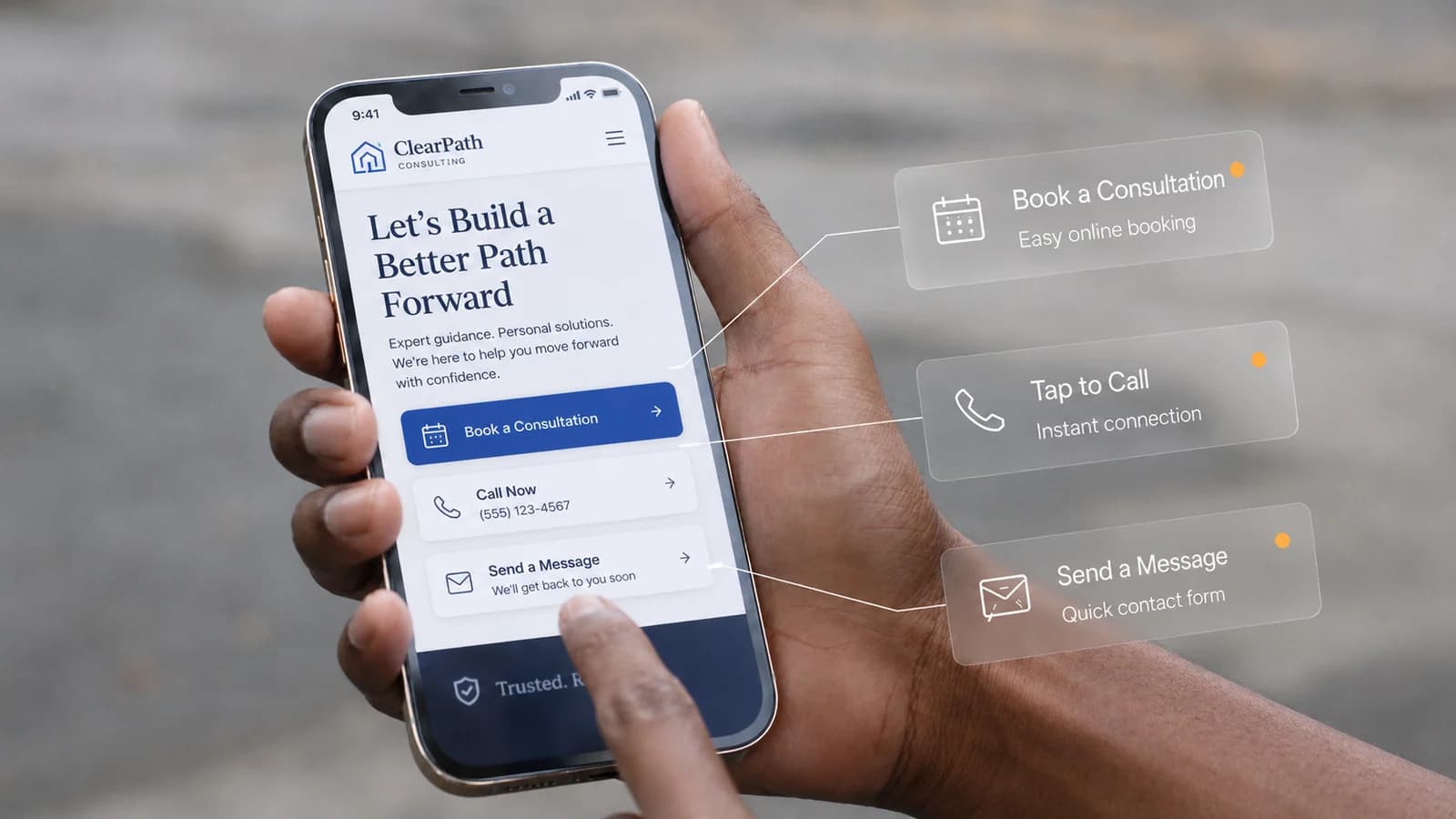
The third failure is often the cheapest to fix and the easiest to miss. Buyers want to inquire and cannot, or the friction is high enough that they do not bother. The common breaks: the CTA appears too late, the form asks too much, the page has no fallback path beyond a form, the phone number is not tap-to-call on mobile, or the booking link is broken or unfamiliar.
The CTA is buried or missing above the fold
The buyer cannot see the action the page wants them to take early enough. Or the page gives them several actions with no clear priority. The fix is one visible primary action early on the page, then repeated at natural decision points.
The form asks too much, too soon
A first-touch form with twelve fields is asking for a relationship before the introduction. The fix is to ask only for what is needed at first contact, then move deeper qualification into a structured intake flow when the lead is ready.
There is no fallback path beyond a form
Some buyers will not fill in a form ever. The page needs an email address shown plainly, a phone number, or a calendar link as a second option.
The phone number is not click-to-call on mobile
A phone number rendered as plain text on mobile can cost calls that would have happened with a tap. The fix is small, but the miss is easy to overlook.
The booking link is broken or off-brand
The button leads to a third-party site the buyer does not recognize, or to a 404, or to a calendar with no real availability. This is where web development work matters: the site has to carry the buyer through the action, not hand them a dead end.
A ten-minute self-diagnosis
Most articles stop at the list and leave the reader to guess which cause is theirs. The four checks below are the fastest way to narrow it down. The first one that fails is usually the fork to start with.
- Sessions check (2 minutes). Open Google Analytics. Filter to the last 30 days. Look at total sessions. Very low traffic usually points to Fork A: not enough buyers are arriving. If traffic is meaningful for the age and size of the business, move to check two.
- Search Console check (3 minutes). Open Google Search Console. Look at impressions and clicks for the last 28 days. High impressions and low clicks mean the page is showing up but not earning the click; the title or meta description is the issue. Low impressions on both means Fork A: the site is not ranking for buyer queries in the first place.
- Seven-second test (1 minute). Open the homepage on a phone, in an incognito window, with the timer running. After a few seconds, look away. Can a stranger tell who the business is for, what it does, and what to do next? If no, Fork B1: the page is not earning trust or clarity.
- Contact path test (4 minutes). From a phone, try to inquire three ways: the main CTA, the phone number, and any booking link. If any fail, are buried, or feel friction-heavy, Fork B2: the contact path breaks. Many sites fail one of these without the owner knowing
The check is honest, free, and takes about ten minutes. It can narrow the problem to a likely fork. The free Website Audit gives a page-level read on website health, SEO, and AI visibility. The free SEO Audit widens that to a crawl of up to 25 pages with pass, warn, and fail verdicts on the site structure. A Strategic Website Audit can add the wider context, name the specific issue, and turn the findings into a prioritized fix plan.
What a real fix looks like
A real fix starts with the named cause, not a guess. Palisades Lodge, a new lodge in California's Eastern Sierra, came to the studio with two distinct constraints: thin local-search visibility and friction in the booking-engine handoff. The work that followed treated each on its own.
The search-side work covered Google Business Profile launch, review operations, local-search architecture, and supporting destination content. The booking work, separately, produced a custom Mews-connected interface with date and party-size controls before the booking-engine handoff. The Palisades Lodge case study holds the dated results and live implementation proof without treating profile interactions as leads or reservations.
The pattern across the studio's audit work is the same. Diagnose the fork, name the specific cause, then fix the right thing. Skip the diagnosis and the fix is a guess. Worse, an owner can end up paying for the wrong fix and concluding the underlying problem is unsolvable.
What this article cannot help with
Two real causes of “no leads” may sit partly outside the website, and a website fix alone will not solve them.
How fast you follow up. A lead that arrives through the site and waits hours for a reply may already be comparing other options. Speed of reply is partly a calendar and inbox problem, not only a website problem.
Whether the leads are qualified. Some sites produce plenty of inquiries from the wrong buyers. That is often a positioning and targeting problem upstream of the site. The site can be tightened to filter for fit, but the targeting question may need to be solved before page-level fixes will help.
Both matter. Neither is what the free page-level audit is built to fix by itself. Calling them out keeps the diagnosis honest.
When to run the free audit
The checks above are enough to narrow the problem to a likely fork. They are not enough to name the specific issue or rank the fixes against each other. The free Website Audit takes about one minute, scores one submitted page across website health, SEO, and AI visibility, and returns the top issues in plain language. It is the fastest way to move from "something is wrong" to a clearer first read on what the page is showing. No call is required to see the result.
The same one-minute free Website Audit is the fastest first step. For sites that need a human review instead of a page-level read, the Strategic Website Audit covers the paid option.
Frequently asked questions
How long before a new website should be getting leads?
Is this a traffic problem or a website problem?
Will more SEO fix it?
How do I know if it is the website or my follow-up?
Should I redesign, or fix what I have?
Find the bottleneck before you spend on the fix
The free Website Audit takes about a minute, scores a single page across website health, SEO, and AI visibility, and returns the top issues in plain language.