

Hotel SEO for independent properties: how guests find you before they know your name
A practical hotel SEO audit for independent properties: Maps, Google hotel results, destination pages, authority, AI visibility, and measurement.
An independent hotel can rank first for its own name and still be almost invisible to new guests. Branded search proves that people who already know the property can find it. Hotel SEO has a harder job: make the property discoverable while a traveler is choosing a destination, comparing an area, or deciding what kind of stay fits.
That discovery does not happen in one ranked list. A guest might meet the property in Google Maps, a Google hotel result, an attraction search, a tourism-board page, an AI answer, or a guide written by someone who actually knows the place. Each surface has different inputs. Treating all of them as “rankings” hides the real problem.
This guide is an audit for independent hotels, inns, lodges, and destination properties. It separates the systems Google uses, shows what the property website must contribute, and draws a line between visibility and a completed reservation.
Start with the missing discovery surface
Hotel search visibility is a system, not a single score. Audit brand results, Maps, Google hotel modules, the property website, destination searches, third-party mentions, and measurement separately. The first weak surface usually tells you whether the next investment belongs in local SEO, hotel distribution, content, web design, or analytics.
Brand search
- Question
- Can a guest who knows the name identify the official property?
- Evidence
- Official site, accurate profile, consistent name and location
- Likely owner
- Website and local SEO
Maps and local results
- Question
- Does the property appear for relevant searches in its actual area?
- Evidence
- Profile accuracy, categories, photos, reviews, local prominence
- Likely owner
- Local SEO and property operations
Google hotel results
- Question
- Can travelers see current direct rates and availability?
- Evidence
- Hotel Center connectivity, accurate rates, landing-page match
- Likely owner
- Booking provider, distribution, and revenue operations
Unbranded organic search
- Question
- Does the site answer a real stay or destination decision?
- Evidence
- Strong property pages, useful local knowledge, crawlable structure
- Likely owner
- SEO, editorial, and website
Third-party discovery
- Question
- Is the property present where the destination is already trusted?
- Evidence
- Relevant associations, tourism pages, partners, press, and reviews
- Likely owner
- Partnerships, PR, and operations
Measurement
- Question
- Can discovery be connected to a booking outcome?
- Evidence
- Search data, profile actions, cross-domain analytics, booking reports
- Likely owner
- Analytics, booking provider, and revenue operations
Search the property name, the town, a relevant stay type, and one nearby demand driver. Use a clean location-aware browser, then compare the results with Search Console, Business Profile performance, Hotel Center, analytics, and booking-system reports. A manual search is a clue, not a rank-tracking system.
1. Make the property legible to Google
The Google Business Profile should describe the real property accurately and give guests enough evidence to choose it. Google says local results are mainly based on relevance, distance, and prominence. That means profile completeness and reputation matter, but no agency can guarantee a particular map position or override the searcher's location.
Check the property name, primary and secondary categories, address or map pin, phone, official website, amenities, check-in details, and photos against the website and booking system. Remove old links and duplicate profiles. Use the most specific truthful categories rather than adding loosely related services in the hope of ranking for more searches.
Reviews are operational evidence, not a keyword-delivery service. Ask real guests consistently, respond like a host, and look for repeated themes that should be clarified on the site. Do not script review language or treat volume as a guaranteed ranking lever. Google's own local ranking guidance says positive reviews and ratings can help prominence, alongside other signals.
The studio's local SEO work for service and place-based businesses covers profile accuracy, reputation workflows, local citations, on-site signals, and measurement as one connected system.
2. Put direct rates in Google hotel results
Google's hotel modules are not the same as the map pack or ordinary organic results. Eligible properties can connect rates and availability through Hotel Center so a traveler can compare booking options and follow a free booking link to the official site. This is a distribution and data-feed problem as much as an SEO problem.
Google's hotel owner starter guide separates property management from rates, availability, and direct booking links. In practice, the booking engine, connectivity partner, central reservation system, or channel manager may control the feed. Confirm who owns it before asking a content team to fix missing prices.
Then inspect the direct landing page. The dates, guests, room, currency, total, and cancellation terms should survive the handoff. Google recommends accurate, complete prices and a landing experience that matches what the traveler selected. A visible direct rate creates an opportunity; it does not prove the booking completed.
If the property appears but guests abandon the direct path, move to the separate guide on why boutique hotels lose direct bookings. If the constraint is technical handoff or platform integration, review booking-system development.
3. Give every stay decision a real page
The website must help a traveler decide whether the property fits before it asks for a booking. That usually requires distinct, crawlable pages for rooms or accommodation types, amenities, location, practical policies, groups or events when relevant, and the direct-booking path. One attractive homepage cannot carry every search intent or buying objection.
A strong room page names the accommodation, occupancy, bed configuration, accessibility facts, key amenities, view or location, current imagery, and the next booking step. A location page should explain the property's actual relationship to the town and major demand drivers without pretending it is closer than it is. Policy information should be easy to find before checkout.
Use structured data only for facts visible on the page and supported by the site. Schema can help a search engine understand an entity, article, FAQ, or breadcrumb, but it does not manufacture authority or rankings. The property website and this editorial guide are different entities, so this page should not mark Jardine Studio itself as a hotel.
4. Choose demand the property can actually satisfy
Keyword volume is not a strategy. A useful hotel SEO target joins a real search pattern to a property advantage, an appropriate page, and a plausible next action. Before creating anything, inspect the current results, identify what Google is rewarding, and ask whether the property can offer a more useful answer from first-hand experience.
Property name
- Traveler need
- Verify the official property and continue a known journey
- Best destination
- Homepage, profile, and booking path
Stay type + place
- Traveler need
- Compare a cabin, lodge, inn, spa stay, or other specific fit
- Best destination
- A relevant accommodation or offer page
Hotel near a demand driver
- Traveler need
- Confirm practical proximity and suitability
- Best destination
- A truthful location or demand-driver page
Destination planning question
- Traveler need
- Plan a route, season, activity, or itinerary
- Best destination
- A first-hand guide only when the property has useful knowledge
Broad hotels in a major region
- Traveler need
- Compare large inventories and many property types
- Best destination
- Often an OTA, tourism site, or hotel search module
Do not declare a term “easy” from one difficulty score or impossible because OTAs are present. Search results vary by location, date, device, and query wording. Use the live result type, the property's relevance, existing visibility, competitive pages, and the cost of producing something better. Sometimes the honest decision is not to create a page.
5. Publish destination knowledge only when it earns its place
Destination content should answer a question the property is unusually qualified to answer and move the right traveler closer to a stay. A generic list of attractions adds little. A useful guide includes current logistics, seasonality, travel times, accessibility, closures, who the experience suits, and what the operator has learned from serving guests there.
Start with front-desk questions and booking objections, then verify demand in Search Console, search results, guest messages, and conversations. One complete guide is more defensible than ten thin posts. Update it when roads, operators, hours, fees, or local conditions change. Remove it when the property can no longer maintain the answer.
Palisades Lodge used this model for specific Eastern Sierra decisions, including guides to Big Pine, Highway 395, and the Big Pine Lakes trail. Those pages make the property useful before a traveler knows which lodge to choose. They also link back to relevant stay information instead of turning every paragraph into a sales pitch.
This is where hotel SEO becomes commercial content rather than publishing for traffic. The guide earns attention; the connected property page earns consideration; the booking path handles the transaction.
6. Build authority outside the property website
A property cannot create all of its own prominence. Relevant tourism organizations, hotel associations, local partners, attractions, event organizers, trusted directories, and editorial coverage can confirm that the business belongs in the place it claims to serve. The goal is accurate inclusion and a useful relationship, not bulk directory submissions or purchased links.
Audit the sources already visible for destination and stay queries. Correct inaccurate property details. Pursue memberships and listings that a guest would genuinely use. Build packages, itineraries, or referral relationships with compatible operators when the guest experience supports them. Give journalists and tourism teams clear facts, images, and a stable page they can cite.
Third-party mentions can support discovery even when they do not link. They also influence which sources travelers and answer engines encounter. Keep the name, location, category, and official URL consistent enough that those references point to one recognizable entity.
7. Treat AI visibility as a consequence, not a separate trick
There is no special “AI SEO” switch for a hotel. Google's current guidance for AI features points back to the same foundations used in Search: crawlable pages, useful original content, clear text, accurate structured data, good page experience, and up-to-date Business Profile and Merchant Center information where relevant. Inclusion is not guaranteed.
Write passages that answer a real question directly, then support them with property facts, first-hand detail, and sources a reader can verify. Keep key information in text rather than hiding it only in images. Make the hotel's identity and location unambiguous. Earn relevant mentions on the external sources that already shape destination decisions.
Measure AI referrals and citations when the tools expose them, but do not invent attribution. A guest may see the property in an answer, return through brand search, and book later. That makes AI one discovery surface inside the same system, not a reason to publish generic summaries at scale.
Measure discovery without claiming bookings
Visibility metrics explain whether the property was found; they do not prove revenue. Search Console clicks, profile views, calls, direction requests, website visits, direct-rate clicks, booking-engine starts, and confirmed reservations describe different stages. Preserve the original source across domains and compare channel reports before claiming that SEO produced a booking.
Build a simple measurement chain:
- Search demand: non-brand queries, impressions, clicks, and landing pages in Search Console.
- Local discovery: Business Profile views and actions, segmented by surface and device when available.
- Website consideration: engaged visits to rooms, location, offers, policies, and the booking entry point.
- Booking intent: date searches, room or rate results, and checkout starts.
- Commercial outcome: confirmed reservations, cancellations, net revenue, and acquisition cost from the systems that can verify them.
If cross-domain tracking breaks at the booking engine, fix that measurement gap before assigning credit. If privacy settings, provider limitations, or offline behavior prevent a clean connection, state the limitation. More organic sessions and higher direct revenue are different claims.
What the Palisades work proves
The Palisades Lodge work shows that an independent property can build measurable discovery assets across its website and Google Business Profile. It does not prove that every profile view became a guest, that destination content alone caused the activity, or that another property will achieve the same result.
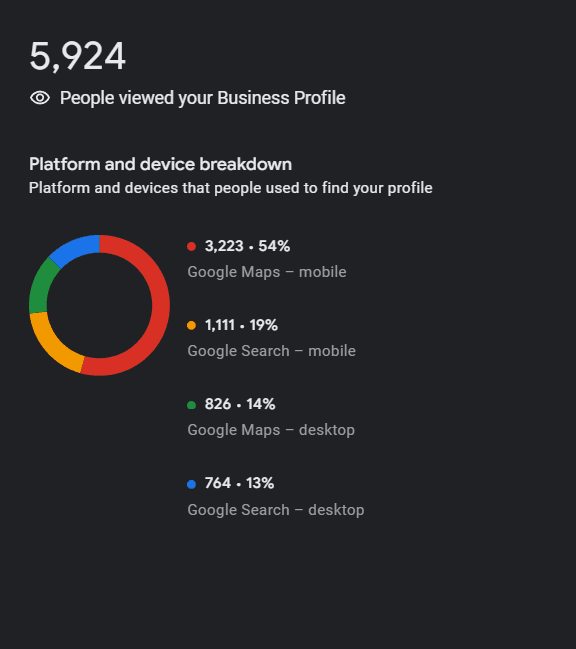
The image is an earlier operational snapshot, included to show how profile discovery can be split by surface and device. It is not the final reporting window. From May to October 2026, the profile was viewed 12,006 times and recorded 1,433 interactions. By October 2, 2026, it had 42 Google reviews with a 4.7-star average.
Jardine Studio's work included the profile launch, local-search architecture, review-program support, and destination content. Those are implementation and visibility outcomes. Booking volume, occupancy, revenue, and return on investment were not verified for this case and are not claimed here. The Palisades Lodge case study holds the complete scope and evidence boundaries.
When SEO is not the first fix
SEO is not the first fix when the property has no competitive inventory, poor availability, unclear pricing, a broken booking engine, weak operations, or an offer guests do not want. It is also premature when the official site cannot explain the stay or analytics cannot distinguish discovery from a completed reservation.
Fix distribution when rates or availability do not reach the right surfaces. Fix the website when important stay decisions have no clear page. Fix the booking path when context disappears at the handoff. Fix operations when reviews repeatedly identify the same real failure. Use paid demand when the business needs controlled reach while slower organic work develops.
A hospitality website and growth engagement can span those systems, but the scope should begin with evidence. Jardine Studio's broader SEO work is appropriate when technical access, search architecture, content quality, authority, and measurement need to be solved together.
Run the hotel discovery audit in 30 minutes
This short audit will not replace market research, rank tracking, revenue data, or an operator interview. It will reveal obvious gaps and assign each one to the right system. Use a real property, one realistic stay, a phone, and the reporting access already available to the team.
Verify the known-property result
Search the exact property name. Confirm the official site, profile, location, phone, photos, and direct-booking path agree.
Test the local discovery result
Search the town and one relevant stay type. Record Maps, hotel modules, organic results, and the property’s actual presence without assuming one search is representative.
Inspect direct rates
Choose real dates and guests. Confirm direct availability, price accuracy, landing-page match, currency, and policy continuity.
Audit decision pages
Check whether rooms, amenities, location, accessibility, policies, and important demand drivers have clear crawlable destinations.
Challenge the content estate
Keep guides with first-hand usefulness and a commercial path. Consolidate or remove generic, stale, overlapping, or unsupported articles.
Check external authority
Review tourism sites, associations, partners, directories, press, and reviews for accuracy, relevance, and missing high-value relationships.
Trace one booking
Follow discovery through the website and booking engine. Confirm which source, action, and commercial outcome each system can actually verify.
Write down the first missing or contradictory surface, the evidence behind it, and the system owner. That is the first scope. If several layers fail, sequence them so foundational accuracy and measurement come before expansion.
Use those findings to choose between an SEO audit, a focused project and ongoing work. A known discovery gap can become a bounded project; a continuing set of useful opportunities may justify monthly work.
If you want an outside view, send Jardine Studio the property and market. The first conversation maps the discovery gaps and identifies which ones are worth solving.
Common questions about hotel SEO
These answers cover the decisions independent operators usually face after the audit: Maps, area searches, OTAs, Google hotel results, and AI visibility. They separate what a property can influence from what no consultant can guarantee.
How do small hotels get found on Google without paying for ads?
Why does my property rank for its own name but not for the area?
Can an independent property outrank Booking.com and Expedia?
What is the difference between Google Maps and Google hotel results?
How should an independent hotel prepare for AI search results?
References (5)
- Google. (Accessed August 31, 2026). Tips to improve your local ranking on Google. Google Business Profile Help. https://support.google.com/business/answer/7091
- Google. (Accessed August 31, 2026). Hotel owners starter guide. Google Hotel Center Help. https://support.google.com/hotelprices/answer/11947460
- Google. (Accessed August 31, 2026). About hotel free booking links. Google Hotel Center Help. https://support.google.com/hotelprices/answer/10472393
- Google. (Accessed August 31, 2026). Best practices for free booking links. Google Hotel Center Help. https://support.google.com/hotelprices/answer/10472993
- Google. (Accessed August 31, 2026). AI features and your website. Google Search Central. https://developers.google.com/search/docs/appearance/ai-features
Map your hotel's discovery gaps
Bring the property, market, booking path, and the searches you believe should find you. Jardine Studio will identify which discovery surfaces deserve work and which do not.