

Why boutique hotels lose direct bookings: a 7-point audit
A practical audit for boutique hotels losing direct bookings. Test demand, direct-rate visibility, website trust, booking-engine UX, and measurement.
Boutique hotels rarely lose every direct booking for one reason. Some properties have a demand problem: too few suitable guests reach the official site. Others have a conversion problem: guests arrive, compare the direct path with an OTA, and leave when the rates, policies, rooms, or checkout feel less clear. The first job is to tell those problems apart.
This seven-point audit follows one real booking journey from discovery to confirmation. It shows what to test, which system usually owns the failure, and when a website rebuild is the wrong prescription. It is written for independent hotels, lodges, inns, and small destination properties, not large hotel groups with dedicated revenue, CRM, and development teams.
Do not buy more traffic until you know the booking path can convert it. Do not replace the website until you know the website is the constraint. Find the first measurable break, then fix that layer.
First separate a demand problem from a conversion problem
A direct-booking problem starts before the website or inside it. If qualified guests rarely reach the property site, fix discovery and distribution first. If they arrive but do not start or finish a reservation, inspect the offer, room information, booking-engine handoff, checkout, and measurement before increasing the marketing budget.
Use the evidence you already have to make the first cut:
| What you observe | Most likely problem | Check next |
|---|---|---|
| Very little qualified traffic reaches the property site | Demand or discovery | Search Console, Business Profile, Hotel Center, referral traffic, branded search |
| Guests reach the site but rarely select dates | Offer, trust, or room clarity | First screen, room pages, policies, direct-booking value, booking CTA |
| Guests select dates but few reach a rate or room result | Website-to-engine handoff | Passed dates, party size, availability errors, mobile behaviour |
| Guests reach the booking engine but do not complete | Checkout, payment, rate, policy, or inventory | Booking-engine funnel, payment errors, room and rate presentation |
| The reports disagree or the booking engine appears to lose attribution | Measurement | Cross-domain tracking, booking events, referral exclusions, source capture |
The numbers will not diagnose the cause by themselves. They tell you where to reproduce the journey. Run the same stay through the property site and the OTA from a phone, using real dates, a real party size, and the same room. The first material difference is where the investigation starts.
If discovery is the main constraint, use the separate guide to how destination properties get found online. The rest of this article assumes a guest can reach the official property site and is deciding where to finish the reservation.
The direct-booking path has seven checkpoints
A guest moves through seven distinct checkpoints: official-site visibility, direct value, first-screen trust, room and policy clarity, booking-engine handoff, checkout reliability, and measurement. Treating them as one “website problem” leads to expensive guesses because each checkpoint may be owned by a different person or platform.
| Checkpoint | The guest needs | Typical owner |
|---|---|---|
| 1. Official path | A visible route to the property and its direct rates | Marketing, distribution, booking provider |
| 2. Direct value | A credible reason to book here instead of returning to the OTA | Operator, revenue strategy |
| 3. First-screen trust | Confidence that the site represents the actual stay | Operator, designer, photographer |
| 4. Room clarity | Enough detail to choose a room and understand the commitment | Operator, content, website |
| 5. Engine handoff | Dates, party size, context, and trust that survive the transition | Developer, booking provider |
| 6. Checkout | A fast, usable, and reliable way to pay and confirm | Booking provider, payments, operations |
| 7. Measurement | One attributable journey from source to confirmed reservation | Analytics, developer, booking provider |
This separation matters commercially. A redesign can improve trust and room presentation, but it cannot repair bad inventory rules inside a channel manager. A new booking engine can improve checkout, but it cannot create demand or clarify an undifferentiated property. The correct fix follows the failing checkpoint.
1. Confirm that guests can reach the official path
The direct path cannot convert a guest who never finds it. Check whether the official website owns the branded result, whether the Google hotel module shows a usable official rate, and whether local and destination searches send suitable visitors. This is a visibility check, not a demand-generation plan hidden inside a conversion audit.
Start with the property name plus its town. Confirm that the official site is easy to distinguish from Booking.com, Expedia, Tripadvisor, and similarly named properties. Then test the hotel result with real dates. Google's free booking links can send a traveler to the landing page supplied by the hotel or its booking partner, and Google says value, landing-page experience, and price accuracy affect how those links are ranked.
If your booking provider supports Hotel Center, verify that the property is matched correctly, rates are current, and the selected room and rate survive the click. Google's own free-booking-link guidance tells partners to send users to the chosen room and rate, keep the displayed price accurate, and provide a functional landing page. A generic homepage or reset search weakens a high-intent arrival.
OTAs still contribute discovery. SiteMinder's 2026 traveler survey, based on almost 12,000 respondents across 14 countries, reported that 18 percent of travelers who started on an OTA later booked with the hotel directly. Older Cornell research called this cross-channel behaviour the billboard effect. The Cornell work is useful historical context, not a current benchmark for an individual property.
The goal is not to eliminate the OTA. It is to make the official path clear and credible for guests who choose to compare it.
2. Give the guest a defensible reason to book direct
The official site needs a concrete advantage, not a vague “best rate” badge. Compare the direct rate, cancellation terms, fees, room choice, arrival flexibility, and included extras against the same stay on the OTA. If the guest receives the same offer through a more familiar checkout, convenience favours the OTA.
A direct-booking advantage does not have to be a public discount. Depending on the property's contracts and market, it can be:
- a clearly matched rate;
- more flexible changes or cancellation;
- parking, breakfast, a welcome item, or another useful inclusion;
- access to a room type or package not listed elsewhere;
- clearer communication before arrival;
- a meaningful preference such as late checkout, subject to availability.
Do not promise an upgrade the operation cannot honour or hide important conditions in a tooltip. The benefit should be specific enough to compare and operationally realistic enough to deliver.
Rate-parity rules are not universal. In the European Union, the European Commission confirmed that Booking.com must allow hotels to offer better prices and conditions through other channels under the Digital Markets Act. That does not automatically describe every contract or jurisdiction. Check the current agreement and obtain professional advice where the commercial or legal consequence is material.
3. Make the official site at least as trustworthy as the OTA listing
The property site must confirm the stay the guest saw elsewhere. If the OTA has newer photography, clearer room names, stronger review evidence, or more practical information, the official site creates doubt at the exact moment it should be earning confidence. Boutique character only helps when the page also answers the booking questions.
Compare both versions side by side on a phone:
- Are the room names and photographs consistent?
- Does the official site explain what is distinctive about the stay?
- Are location, parking, accessibility, check-in, and important restrictions easy to find?
- Are reviews current and attributable to a real platform?
- Does “Book” remain visible without covering the content?
- Does the site feel current, secure, and clearly connected to the property?
A beautiful homepage can still lose the reservation if the guest has to return to the OTA to understand the room. The hospitality website work treats the property story, practical information, local discovery, and booking path as one guest experience, while keeping each constraint measurable.
4. Let guests compare rooms, rates, and policies without decoding them
Room selection is a decision interface. Guests need to understand why two rooms cost different amounts, what each rate includes, when payment is taken, and what happens if plans change. Vague room categories and buried policies create uncertainty that an OTA's familiar comparison layout may resolve faster.
For each room and rate, check whether the guest can answer:
- How many people can stay here comfortably?
- What is different from the next room category?
- Which bed, view, floor, bathroom, or accessibility details matter?
- What is included in this rate?
- Which taxes and mandatory fees will appear?
- When is payment taken?
- What are the change and cancellation conditions?
- What happens if no room is available for the chosen dates?
Do not solve weak information with more adjectives. “Deluxe,” “premium,” and “signature” are not useful differences by themselves. Measurements, layouts, views, sleeping arrangements, inclusions, and policies help a guest choose.
Unavailable dates also need an intentional response. Offer nearby dates, another room configuration, a waitlist, or a contextual inquiry when the operation can support it. A blank result or unexplained “no availability” message sends a motivated guest back into comparison mode.
5. Preserve context during the booking-engine handoff
The booking engine should receive the information the guest already supplied and make the transition feel intentional. Re-entered dates, reset party size, an unfamiliar domain, changed styling, or an unexplained loading state all introduce doubt. The website and engine may be separate systems, but they should behave like one booking path.
Test the handoff with several realistic cases:
- One room for two adults.
- A family or group near the room's occupancy limit.
- Same-day or late-night arrival.
- Dates crossing a rate or seasonal boundary.
- A stay with no direct availability.
- A return to the property site after viewing rates.
Check what survives: arrival and departure dates, adults and children, promo codes, room context, language, currency, and source attribution. Then check failure states. If the engine is closed, delayed, or unable to satisfy the request, the guest needs a clear next step rather than a dead end.
This is where custom development can be useful without replacing the property's PMS or booking engine. The studio's booking-system development can improve the interface and handoff around an existing platform when the platform remains the right operational choice.
6. Test checkout on the device and conditions guests actually use
A booking engine can display rates correctly and still fail during checkout. Test the complete reservation on a phone, on a slower connection, with autofill, validation errors, and the payment methods guests use. Count required fields and confirm that the total, currency, cancellation terms, and payment timing remain clear.
The useful test is not “does the booking page load?” It is whether a first-time guest can complete a real reservation without assistance.
Check:
- tap targets, keyboard behaviour, focus, and form labels;
- address and telephone formats for international guests;
- clear inline validation that preserves entered information;
- visible total price, taxes, mandatory fees, and currency;
- cancellation and payment terms before the final action;
- supported cards, wallets, and authentication steps;
- confirmation on screen and by email;
- recovery from a declined or interrupted payment;
- a usable route to call or inquire when checkout cannot complete.
Do not infer abandonment from one awkward interaction. Reproduce the problem, review the booking-engine funnel where available, and ask front-desk staff what guests report. A repeated failure at the same step is a stronger signal than a general feeling that the engine looks dated.
7. Measure one journey across the website and booking engine
Without reliable measurement, the property cannot distinguish weak demand from a broken handoff or checkout. Track the important steps from the original source through confirmed reservation, and verify that moving to a separate booking-engine domain does not create a new session or overwrite the acquisition source.
At minimum, the reporting should answer:
- Which channels send qualified visits to the official site?
- How many visitors open the date selector?
- How many receive room and rate results?
- How many begin checkout?
- How many reach confirmation?
- Where does the largest material drop occur?
- Which booking source is stored with the reservation?
- Do mobile and desktop behave differently?
When the website and booking engine use different domains, configure and test cross-domain measurement. Google's GA4 cross-domain documentation explains that otherwise one person can be counted as separate users and sessions when crossing domains. The booking provider must also expose a trustworthy confirmation event or reporting boundary. A click on “Book” is not a completed reservation.
Use the smallest event set that supports a decision. More dashboards do not repair weak attribution. A consistent funnel with clear definitions is enough to identify where the next investigation belongs.
What the Palisades booking work proves
Palisades Lodge provides first-hand implementation evidence for the handoff layer. The studio built a Mews-connected interface that keeps date and party selection on the lodge site, validates dates in the property's timezone, handles a property-specific overnight booking case with a telephone fallback, and otherwise passes the guest into Mews to continue the reservation.
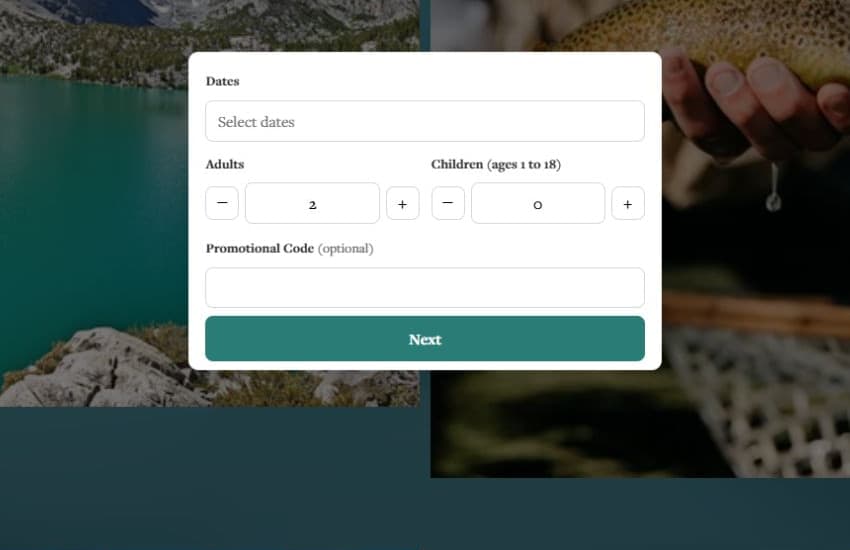
The implementation matters because it handles real edge cases rather than treating the booking button as a decorative link. The party controls respect the property's rules. Date validation uses the property timezone rather than the visitor's device clock. The overnight fallback gives the guest a telephone path when the selected dates meet the property's overnight rule.
This shows how the booking flow was built, not what it did to bookings: there is no measured change in direct-booking volume, conversion, occupancy, or revenue to report. The Palisades Lodge case study separates the Mews implementation from the property's measured local-search and reputation work.
When the website is not the first fix
A website rebuild is not the first fix when the property lacks demand, direct inventory is disadvantaged, rates are uncompetitive, policies are the real objection, or checkout failures live entirely inside a third-party engine. The website should be changed only when evidence places a meaningful constraint in the experience it controls.
Keep the current website when it communicates the property accurately, loads reliably, presents rooms and policies clearly, and hands guests into a usable booking flow. A focused change to rate messaging, room content, tracking, or date selection may be enough.
Consider a broader web design engagement when the property's story and practical information are structurally weak across the site. Consider booking-system work when context disappears at the handoff or the selected platform cannot support the required journey. Ask the booking provider or revenue lead to own inventory, rate-plan, distribution, and checkout constraints that sit outside the website.
The discipline is simple: fix the first measurable break, not the most visible surface.
Run the audit in 30 minutes
Use one real stay and one phone to reproduce the direct journey. This quick pass will not replace funnel data or an operator review, but it will expose obvious discontinuities and tell you which system deserves a deeper investigation.
Find the official path
Search the property name and town. Confirm the official site and direct rate are easy to identify.
Compare the same stay
Use one room and date range on the official site and the OTA, including the total, policies, and direct-booking benefit.
Review trust on a phone
Check the first screen, room page, practical information, and recent review evidence from a phone.
Test the handoff
Select dates and party size. Confirm those values survive the move into the booking engine.
Try the edge cases
Use a family or group case, unavailable dates, and a late-night or same-day case where the property supports it.
Continue through checkout
Check totals, currency, fees, cancellation terms, validation, payment, and recovery paths.
Verify the measurement
Confirm that analytics and booking reports can connect the original source to a confirmed reservation.
Write down the first failure that would make a reasonable guest stop or return to the OTA. Identify the system and owner responsible. That is the first scope. If the journey completes cleanly but direct share remains weak, return to demand, distribution, the direct offer, guest retention, and revenue strategy instead of forcing another website change.
If several layers are unclear, send the studio the site, evidence, booking engine, and failing step through the hospitality project brief.
Common questions about hotel direct bookings
The questions below address the decisions that usually follow the audit: whether the engine or website needs replacement, how to compare direct and OTA economics, what can be offered directly, and which measurements are needed before making another investment.
Why do guests leave a hotel website and finish on an OTA?
Does a hotel need a new booking engine to increase direct bookings?
Is a direct hotel booking always more profitable than an OTA booking?
Can a hotel offer a lower price for booking direct?
What should a boutique hotel measure in its direct-booking funnel?
References (6)
- Google. (Accessed August 31, 2026). About hotel free booking links. Google Hotel Center Help. https://support.google.com/hotelprices/answer/10472393
- Google. (Accessed August 31, 2026). Best practices for free booking links. Google Hotel Center Help. https://support.google.com/hotelprices/answer/10472993
- Google. (Accessed August 31, 2026). Set up cross-domain measurement. Google Analytics Help. https://support.google.com/analytics/answer/10071811
- European Commission. (November 14, 2024). Booking must comply with all relevant obligations under the Digital Markets Act. Digital Markets Act. https://digital-markets-act.ec.europa.eu/booking-must-comply-all-relevant-obligations-under-digital-markets-act-2024-11-14_en
- Chris K. Anderson and Saram Han. (2017). The Billboard Effect: Still Alive and Well. Cornell Center for Hospitality Research. https://ecommons.cornell.edu/bitstream/handle/1813/70982/Anderson_2017_The_billboard_effect.pdf
- SiteMinder. (2026). Hotel direct bookings: The complete strategy guide. SiteMinder Resources. https://www.siteminder.com/r/direct-booking-hotel/
Find the broken step before replacing the whole system.
Tell the studio what guests can do today, which booking engine you use, and where the numbers stop making sense. We will separate the website, booking-engine, search, and measurement problems before recommending what to change.