

Why your yoga studio isn't filling classes: a 7-point audit
A practical audit for yoga studio owners. Diagnose demand, schedule fit, local discovery, the intro offer, booking friction, first visits, and retention.
Empty yoga classes are not automatically a marketing problem. The break may sit in local demand, the schedule, how the studio appears in search, the first-visit offer, the booking handoff, the class experience, or what happens after the first visit. A new website can repair some of those failures. It cannot repair all of them.
This seven-point audit is for independent yoga and wellness studio owners who need to find the first measurable break before buying more promotion or commissioning a rebuild. It follows the prospective student from local discovery to a second visit and assigns each failure to the system that can actually change it.
Do not spend more to attract people until you know where the current path loses them. Find the first measurable break, confirm who owns it, and fix that layer before changing everything around it.
First separate an attendance problem from a website problem
A class can stay half empty even when the website works. Before changing the site, compare attendance by class, first-visit bookings, booking completion, repeat visits, and qualified website traffic. The first number that falls short determines whether the next investigation belongs to operations, local discovery, the website, the booking platform, or follow-up.
| What you observe | Most likely constraint | Check next |
|---|---|---|
| Similar classes are quiet across every time slot | Demand, positioning, or programming | Local demand, class concept, price, instructor and market fit |
| Some classes fill while comparable classes do not | Schedule, instructor, format, or class description | Attendance by time, teacher and class type |
| Few suitable local visitors reach the site | Discovery | Google Business Profile, Search Console, referrals and branded search |
| Visitors reach the site but rarely view the intro offer or schedule | Message, navigation, offer, or trust | Mobile first screen, class descriptions, photography and calls to action |
| People start but do not finish booking | Booking friction | Mobile handoff, account creation, availability, payment and errors |
| First visits happen but second visits do not | Experience, fit, follow-up, or offer | Member feedback, class experience and follow-up sequence |
| Reports disagree about where people came from | Measurement | Analytics events, booking-platform reporting and cross-domain setup |
Do not compare one busy Saturday class with one quiet Tuesday class and call the difference a marketing failure. Use several weeks of class-level data, note closures or seasonal changes, and compare like with like. The purpose is not to create an industry benchmark. It is to establish the studio's own baseline.
Audit the seven places yoga studio attendance can break
The useful sequence is demand, schedule fit, local discovery, first-visit clarity, booking completion, first-class experience, and retention. Each checkpoint asks a different question and relies on different evidence. Moving through them in order prevents a weak Tuesday schedule or poor follow-up process from being misdiagnosed as an SEO or website problem.
| Checkpoint | Question | Evidence | Typical owner | Website role |
|---|---|---|---|---|
| 1. Demand | Do enough suitable people want this class in this market? | Capacity, attendance, competitors, inquiries | Owner or operator | Represents the offer |
| 2. Schedule fit | Are classes offered when and how people can attend? | Attendance by time, teacher, format and level | Operator | Explains the schedule |
| 3. Local discovery | Can nearby prospects find and understand the studio? | Business Profile, Search Console, referrals | Owner and SEO partner | Supports relevance and trust |
| 4. First-visit clarity | Can a newcomer identify the right first step? | Page visits, clicks, questions and user tests | Owner and website team | Primary responsibility |
| 5. Booking completion | Can that person finish on a phone? | Booking starts, completions, errors and abandonment | Booking platform and website team | Owns the handoff |
| 6. First-class experience | Does reality match the promise? | Feedback, complaints, no-shows and returns | Owner and instructors | Sets expectations |
| 7. Retention | Does a first visit become a second visit or membership? | Visit history, follow-up and membership data | Operator and CRM | Supports follow-up |
1. Confirm that local demand exists
Start with the classes the studio is trying to fill. Record capacity, booked places, attended places, waitlists and cancellations by class over a useful period. Then look at competitor schedules, recurring inquiries and the language prospective students use. The question is whether the market wants the class, not whether the owner believes it should.
The website can make a real offer easier to understand. It cannot create demand for an unwanted format, an inconvenient location, or a price the local market will not accept. If almost no class in the category fills, validate the offer before paying to send more people to it.
2. Check the schedule, teacher and class description together
If Saturday morning fills and Tuesday afternoon does not, inspect the time, instructor, format, level and description before changing the homepage. A class titled with insider language may also be hard for a newcomer to choose, even when regular members understand it.
Compare similar classes and change one meaningful variable at a time. The website team can make schedules readable, explain levels, answer beginner questions and keep instructor information current. The operator still owns the timetable, staffing and programming decisions.
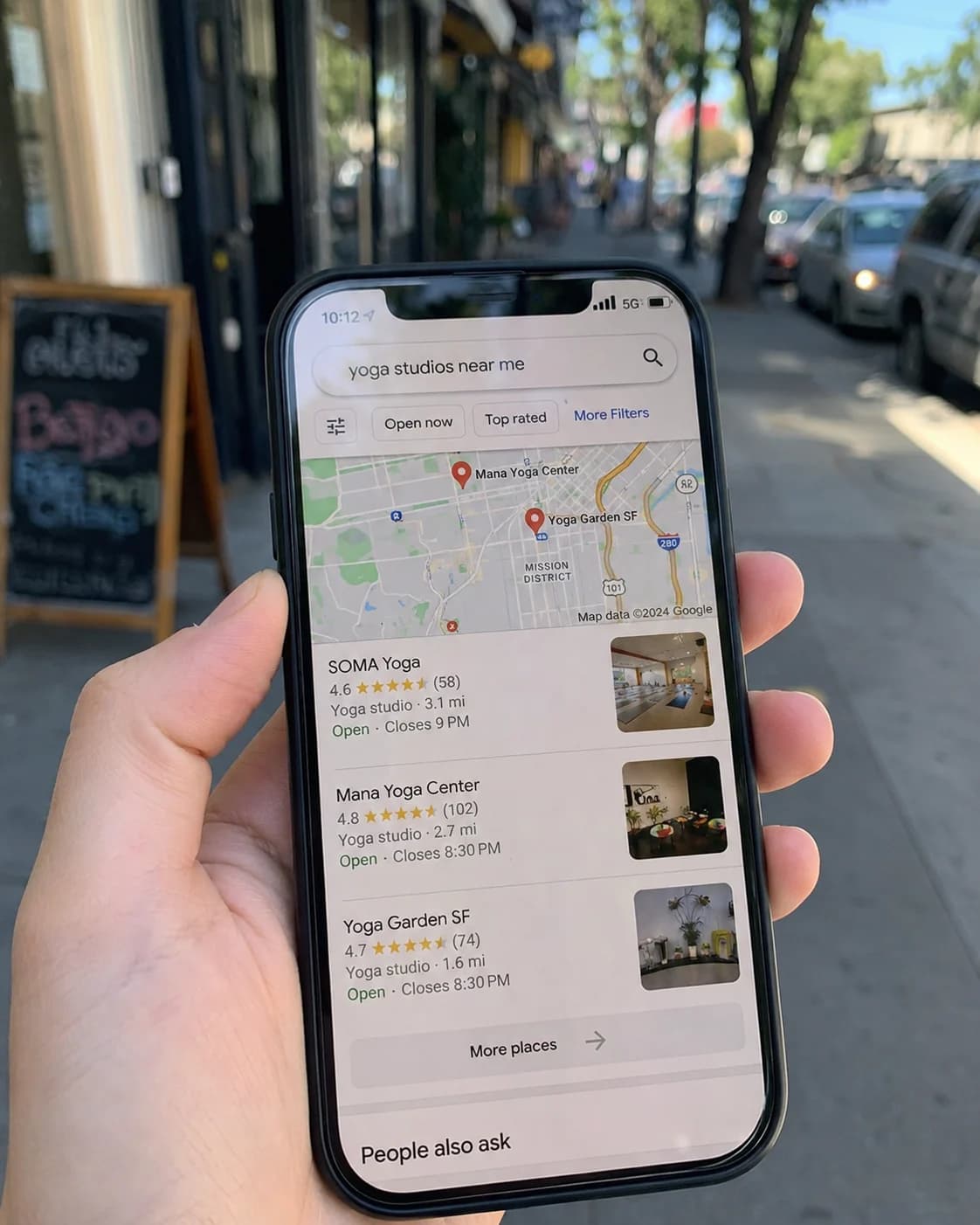
3. Test whether nearby prospects can find the studio
Search Google for the practice, neighbourhood and city from the market the studio serves. Inspect the local results, the studio's Business Profile, the official site and the pages of nearby alternatives. Google says local visibility is mainly based on relevance, distance and prominence, so no consultant can buy or guarantee a particular local position.
A complete and accurate profile helps Google understand what the business is and where it operates. The website should support that information with consistent services, location details, practitioner information and useful pages. This is the role of local SEO for owner-operated businesses, not a reason to publish dozens of interchangeable city articles.
Use Search Console to see whether the site earns impressions for branded, practice and local queries. Use Business Profile performance to inspect calls, website visits and direction requests where available. Treat those as discovery signals, not as proof that someone attended a class.
4. Make the first visit understandable
A prospective student should be able to answer four questions without knowing the studio's language: Is this practice for someone like me? Which class should I choose? What does the first visit cost? What happens after I click?
Test the homepage, beginner information, class descriptions and intro-offer page on a phone. Look for unclear prerequisites, unexplained class names, conditions hidden until checkout, weak photography, anonymous instructors and competing calls to action. The correct fix may be clearer copy and hierarchy rather than a complete wellness website redesign.
Do not judge the offer against a borrowed industry conversion percentage. Booking platforms and consultants define an “intro conversion” in different ways. Establish the studio's own stages: intro-offer view, offer selection, booking start, completed first booking, attended first class, second visit and ongoing membership.
5. Complete the booking from a phone
Open a private browser window and attempt to book as a new student. Choose a real class and follow every step through account creation, waiver, payment and confirmation. Note whether the selected class survives the handoff, whether the interface explains unavailable dates, and whether an error gives the student a useful recovery path.
The studio may use Mindbody, Momence, Punchpass, Acuity, OfferingTree, another platform, or a custom workflow. The brand name alone does not diagnose the problem. Test the configured journey. A good booking-system implementation can preserve context and reduce friction without replacing the operational platform unnecessarily.
If the booking system uses another domain, confirm that analytics can follow the journey across domains. Google's GA4 documentation explains that without cross-domain measurement, one person moving between separate domains can be counted as two users and two sessions. A booking-button click is still not the same as a completed booking.
6. Compare the website promise with the first class
The site sets expectations about pace, level, atmosphere, accessibility, instructor style and who belongs in the room. If the first class delivers something materially different, stronger promotion will only move more people into a mismatched experience.
Review new-student questions, cancellations, complaints and direct feedback. Ask what was unclear before arrival and what surprised the student after it. The website can set a more accurate expectation and prepare someone for the visit. The owner and instructors control the welcome, teaching and in-room experience.

7. Measure the second visit
A completed first booking is an acquisition event, not proof of retention. Track whether the student attends, returns, completes an intro period and chooses an ongoing product. Use the definitions and time windows the studio can reproduce consistently rather than comparing the result with a vendor's undefined benchmark.
If first visits are healthy but second visits are weak, inspect the experience, schedule fit, follow-up and ongoing offer. The website may support email capture, account access and clear membership information, but it cannot repair an impersonal welcome, inconsistent class quality or a membership product people do not want.
Use Black Salt Room as implementation proof, not attendance proof
The Black Salt Room shows what Jardine Studio can verify: a custom wellness website built around a real practice, clear local structure, an inquiry path and measured launch quality. It does not prove that a website increased yoga class attendance, membership, revenue or organic traffic. Those outcomes were not established by the launch evidence.
At its May 2026 launch, the production build recorded:
- 100 Lighthouse scores for Performance, Accessibility, Best Practices and SEO on mobile and desktop.
- Zero cumulative layout shift.
- A 1.5-second mobile Largest Contentful Paint result.
- Approximately $10 per year in hosting and platform cost at launch.
Those measurements show that the site launched fast, stable and technically prepared. The Black Salt Room case study documents the work and its limitations. It is relevant because implementation quality should not create another break in the first-visit path, not because a Lighthouse score fills a class.

Know what the website can and cannot fix
The website can improve discovery support, first-visit clarity, trust, schedule presentation, offer explanation, booking context and measurement. It cannot choose viable class times, improve the teaching, create local demand, repair the welcome or make an unsuitable membership compelling. A credible project scope states that boundary before recommending a redesign.
| The website can change | The website cannot change |
|---|---|
| How quickly a newcomer understands the practice | Whether the local market wants the practice |
| How clearly classes, levels and first steps are explained | Which times the studio can staff profitably |
| Real photography, practitioner profiles and trust signals | The quality and consistency of the class itself |
| The route into a booking platform | The platform's unavailable inventory or payment policy |
| Event tracking and source continuity | An unmeasured historical baseline |
| Search-friendly service and location information | Distance between the searcher and the studio |
| Follow-up triggers and membership information | The relationship the team builds after arrival |
When the website is the first measurable break, scope the smallest intervention that removes it. That may be clearer copy, better mobile hierarchy, a repaired booking handoff, local-search work, analytics, or a rebuild. Custom web design becomes justified when the current system prevents a valuable requirement, not simply because the site feels old.
Run this 30-minute yoga studio attendance audit
Use one real class, one real intro offer and one phone. Record what happens instead of rating the site from memory. The exercise will not solve programming or retention in half an hour, but it should identify the first missing piece of evidence and the person or system responsible for producing it.
Open the attendance report.
Compare capacity, bookings, attendance, cancellations and waitlists for similar classes across several weeks.
Search as a nearby newcomer.
Review the local results, Business Profile, official site and nearby alternatives for the practice and neighbourhood.
Read the first screen without insider knowledge.
Confirm who the studio is for, which first class to choose, what it costs and what happens next.
Book from a private mobile window.
Follow one real class through account creation, waiver, payment and confirmation. Record every reset, surprise and error.
Check the first and second visit.
Compare completed bookings with attendance, returns, intro completion and ongoing membership using consistent definitions.
Assign the first failure.
Name the evidence, system and owner. Fix that layer before funding more traffic or replacing the whole stack.
If the failure sits between the website, local search and the booking platform, send Jardine Studio the site, schedule, intro offer and evidence through the yoga studio first-visit brief. If the failure is programming, instruction or retention, use the audit to brief the operator or specialist who owns that work.
Common questions about empty yoga classes
These answers cover the decisions that usually follow the audit: whether the website is responsible, which numbers matter, whether booking software needs replacement, what local SEO can change, and when a redesign is justified. Each answer keeps the website inside the larger attendance system rather than promising that one channel can fill the room.
Will a new website fill my yoga classes?
What should a yoga studio measure before trying to increase attendance?
Does a yoga studio need new booking software when people abandon booking?
Can local SEO increase yoga studio class attendance?
How do I know whether my yoga studio website is the problem?
References (2)
- Google Business Profile Help. (Accessed August 31, 2026). Tips to improve your local ranking on Google. Google. https://support.google.com/business/answer/7091?hl=en
- Google Analytics Help. (Accessed August 31, 2026). Set up cross-domain measurement. Google. https://support.google.com/analytics/answer/10071811?hl=en
Find the broken step before rebuilding the whole site.
Send the studio your website, schedule, intro offer, booking platform, and the attendance problem you can see. We will separate the website, local-search, booking, and operational issues before recommending what to change.