
The checks behind every site we ship.
A site can look finished and still lose what brings in work: the page Google ranks, the form that sends inquiries, the speed on a phone. These are the checks this site runs on itself, and the standard we bring to client builds.
- pages compared before this page went live
- 59
- checks on every page
- 7
- changes flagged for review, all deliberate
- 4
What this protects for you.
Each habit exists for a business reason. The reason is written for you; the detail further down is written for your developer.
- Search
Updates checked before Google sees them
Every change to this site is compared with the live version before it ships. If a title, heading, link or piece of structured data goes missing, the release stops.
See the check - Readable
Pages Google and AI tools can read
Pages arrive fully written, with structured data that ties your business, services and people together. That makes them easier for search engines and AI answer systems to understand and cite.
See the structured data - Speed
Fast on a phone, measured honestly
We set limits on page weight and layout shift, test on phone-sized screens, and always tell you whether a number comes from a lab test or from real visitors.
See the Lighthouse report - Accessibility
Usable by everyone
We build to WCAG 2.2 AA: readable contrast, touch targets of at least 44 pixels, visible keyboard focus and a reduced-motion version of every animation.
Read our accessibility statement - Security
Forms and data kept secure
Every form is checked on the server and protected from spam, keys for outside services stay on the server, and every page ships with strict security headers.
- Migrations
Redesigns that don’t lose pages
When a site is rebuilt or moved, every old address gets a tested redirect to its new page, so the links people and Google already have keep working.
See how we plan a move
Every change is checked before it goes live.
Our own site runs a page guard on every proposed change. It loads every page in the sitemap twice, once as it is live and once with the change, and compares what search engines and readers rely on.
New pages and links are reported, never blocked. When we change copy on purpose, the change is labelled so the guard lists it instead of stopping it. Anything else that goes missing stops the release until someone looks.
For your developer: a Playwright snapshot of each sitemap URL, compared in GitHub Actions on every pull request.
$ node scripts/page-guard.mjs compare main/ branch/note /partners: added links /how-we-build, /work/black-salt-room, …note /services/seo/technical-seo: added links /how-we-buildnote new page: how-we-build.jsonFAIL /contact: heading outline changed; added: H2 Bringing a client project?FAIL /contact: lost numbers: next01, brief02, day03FAIL /partners: heading outline changed; lost: H2 Why partners trust the handoff.; …FAIL /services/seo/technical-seo: heading outline changed; added: H2 Proof that …59 pages compared, 4 failure(s).Real output from 21 October 2026, trimmed. All four were deliberate: a rewritten partners section, a new technical SEO section and two contact page edits, including a step list we stopped numbering. The guard still listed every one, so each was reviewed on purpose before the change shipped.
| What it compares | Stops the change when |
|---|---|
| Title, description, canonical and robots | Any change |
| Heading outline | A heading is lost, reworded or moved |
| Internal links | A link to another page disappears |
| Structured data | A JSON-LD block changes or is removed |
| Numbers and sentences | A number disappears, or a sentence loses most of its words |
| JavaScript | A page ships more than 10% or 20 KB more, whichever is larger |
| Layout shift | A page shifts more than before, by over 0.02 |
Built to be read by search engines and AI assistants.
Every page is rendered on the server, so its words, links and prices are in the first response, before any script runs. Structured data then describes what the page is about in a form machines can follow.
The descriptions connect to each other: a service page names the service, the service names the studio, and the studio names its founder. Search engines and AI answer systems get one consistent picture of who you are and what you offer, instead of disconnected fragments.
- The SEO migration pageWebPage · /services/seo-migration#webpageis aboutSEO Migration ServicesService · /services/seo-migration#service
- SEO Migration ServicesService · /services/seo-migration#serviceprovided byJardine StudioOrganization · /#organization
- The SEO migration pageWebPage · /services/seo-migration#webpagepart ofjardinestudio.comWebSite · /#website
- The SEO migration pageWebPage · /services/seo-migration#webpagepublished byJardine StudioOrganization · /#organization
- The SEO migration pageWebPage · /services/seo-migration#webpagebreadcrumbHome › Capabilities › SEO migrationBreadcrumbList · /services/seo-migration#breadcrumb
From the JSON-LD on /services/seo-migration. Each id is shared site-wide, so every page points at the same studio.
Speed you can check yourself.
At its May 2026 launch, The Black Salt Room site we built scored 100 in Lighthouse for performance, accessibility, best practices and SEO, on mobile and desktop, with zero layout shift and its main content loaded in 1.5 seconds on a phone.
Lighthouse is a lab test: one controlled visit, run when we choose. Real-visitor speed comes from Chrome's field data once a site has enough traffic to report it. We always say which one a number comes from.
See how we built The Black Salt Room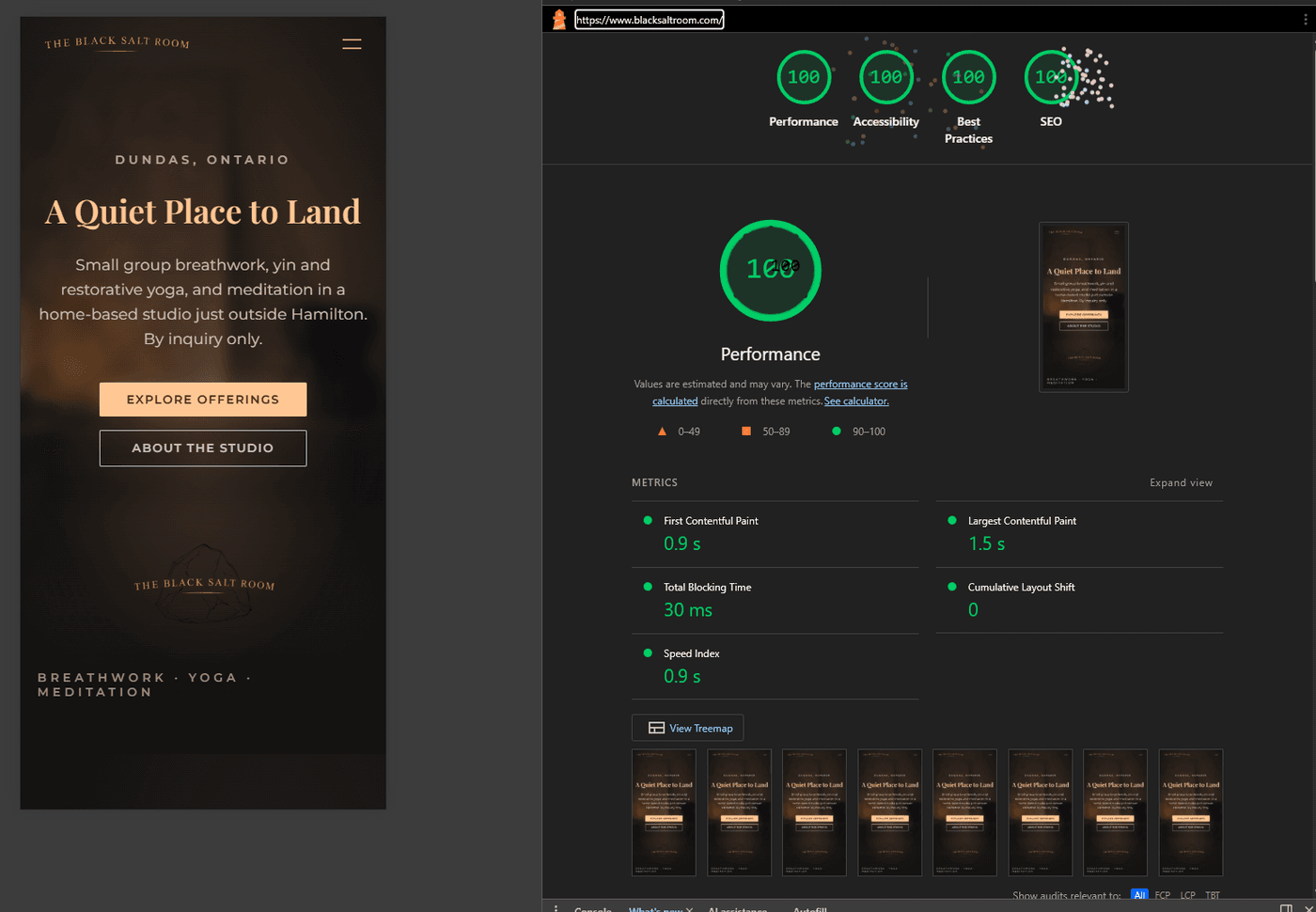
The site behind these claims.
Everything on this page runs on the site you are reading. These figures come from its own code, so you can ask us to show you any of them.
- Automated tests
- 1,400+
- Structured data types
- 11
- Managed redirects
- 53
- Browser test suites
- 14
Counted on 21 October 2026. The automated tests are unit and component tests run on every change; the browser suites, including accessibility scans, run in a real browser before release.
Redesigns that don’t lose pages.
A redesign is where search traffic usually goes missing. We inventory every old address, map each one to its closest new page, test the map before launch and watch Search Console afterwards.
Alex holds his own work to the same standard. When he moved his portfolio to a new platform, he compared 212 before-and-after screenshots of the old and new pages before launch, and published the record.
Questions about how we work.
Do I need to understand any of this?
Will this improve my rankings?
Can you work this way on a site someone else built?
Can our developer or agency see the checks?
Want a site built this way?
Tell us what the site needs to do. Alex replies within one business day.