

How customers check a local service business online before they call
What customers look for before contacting a local service business, from relevant work and checkable qualifications to reviews and clear inquiry expectations.
Someone finds your business on a map listing, or gets your name from a neighbour. Before they pick up the phone, they want a few answers. Do you do this kind of job? Do you work where they are? Is there anything behind your claims? What happens if they get in touch? A confident headline helps only when the information behind it holds up.
The useful work is making those answers easy to find. Your website, business listings, reviews and project examples should let someone connect what you say with evidence they can inspect.
The first decision is whether a conversation is worthwhile
Before contacting you, someone may be checking service fit, qualifications, other customers' experiences or how much effort it will take to get an answer. Which of these matter depends on the job and on what the person already knows. Treat them as questions your online presence should answer, rather than steps every customer follows in order.
An urgent repair and a planned commercial contract look very different. A homeowner with a leak might call straight from a map listing to ask about availability. A property manager might compare service scope, relevant experience and the documentation each provider supplies before calling anyone. A recommendation from a friend can shorten either search, but it rarely settles the practical questions.
Survey data points the same way. BrightLocal asked 1,227 US consumers who had recently searched for a local business what influenced which one they contacted or visited. Clear and complete business information, reviews and clear pricing or offers came out on top. At the research stage, people looking for trades and home services put more weight on reviews and pricing or offers than people searching in other categories. This is self-reported US data, so treat it as context rather than a forecast of how your own customers behave. BrightLocal's consumer search research
Your job is not to remove every reason someone might choose another provider. Price, capacity, timing and fit still matter. It is to avoid leaving the right customers unsure about facts you could have made clear.
They need to recognize the business and their kind of job
Give people enough detail to connect the company they found with the work they need. A recognizable business name, specific services, a genuine operating area and identifiable people provide that starting point. Broad promises about quality leave the visitor to work out whether you are even relevant.
"Property maintenance" might mean grounds care, interior repairs or commercial building services. Those are different inquiries. Name the work you take on, separate residential from commercial where that matters, and state meaningful limits. If you handle planned maintenance but not emergency call-outs, make that visible before someone calls at 11 p.m.
For B&B Specialty Contractors, the studio organized the website around six service groups, including drywall and paint, flooring, and finish trim, with coverage across the Greater Toronto Area and one consistent route to request an estimate. Each group describes the work included, and the homepage links into each one. The reasoning is simple: someone who needs flooring should be able to confirm that flooring is part of the work before they ask for a price.
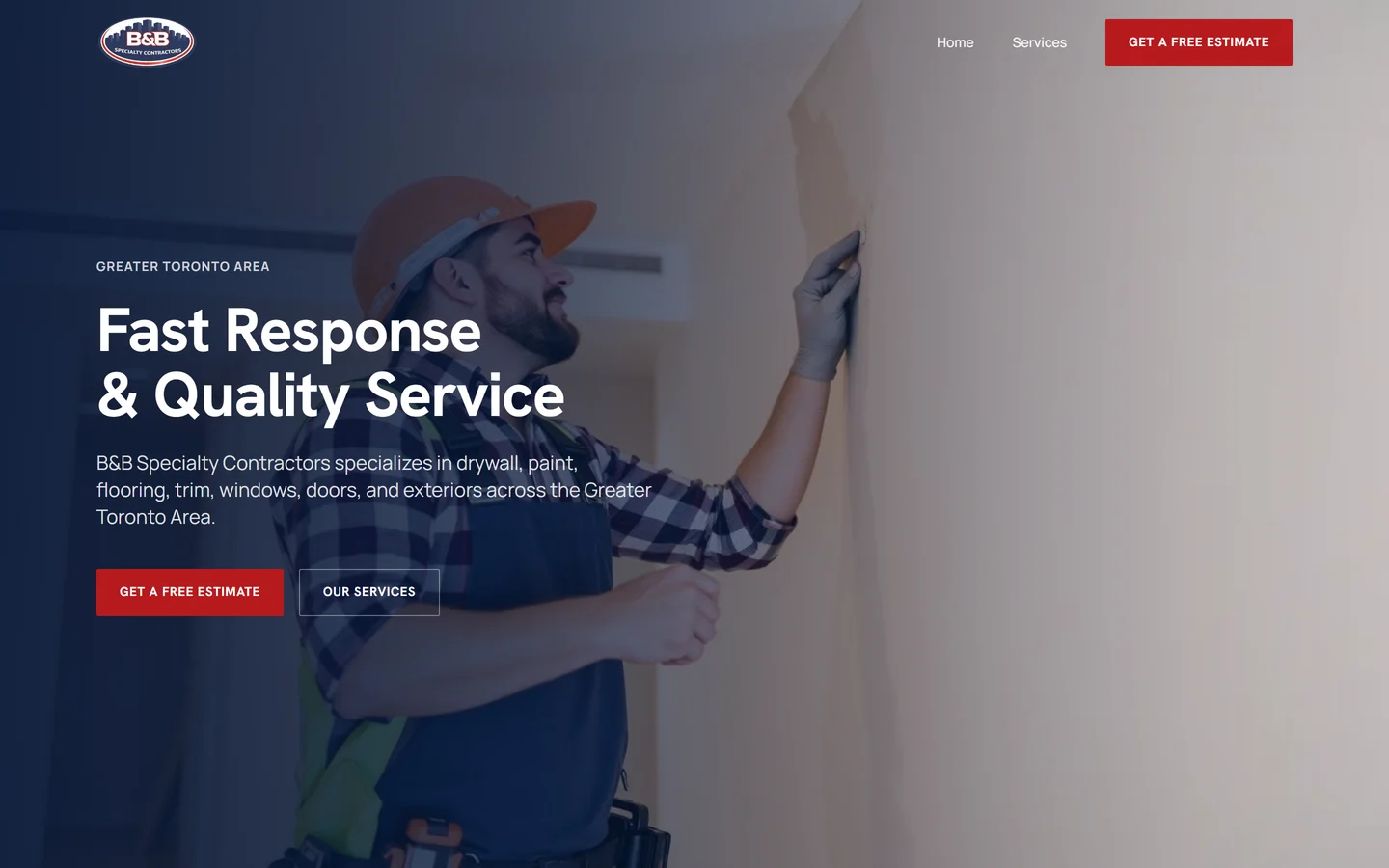
The B&B homepage puts service names, its operating area and the estimate action together.
Location needs the same care. State where you actually work and whether coverage changes by service. Serving a town does not mean you have an office there, so avoid wording that implies one.
A missing public street address, by itself, is not a reason to distrust a business that goes to its customers. Google's guidelines tell service-area businesses that do not receive customers at their address to hide it on their Business Profile, and Google's own example is a plumber running the business from home. A home-based operator can still describe the service area clearly and give reliable contact details. Google's business representation guidelines
The About page answers a different question: who is responsible for the work? Use real names, roles and relevant experience. If the company is new but its founder spent years in the trade elsewhere, say exactly that. A person's career and the company's trading history are different claims, and the website should make that distinction clear.
Different evidence answers different questions
A project photograph, a customer review and a licence record each tell a prospective customer something different. Show the evidence that supports the claim you are making, and give enough context for someone to judge its relevance. A row of badges cannot replace knowing what each one means or who issued it.
| What the customer sees | What it can help establish | What it leaves unresolved |
|---|---|---|
| A project example with a clear account of your role | Experience with a relevant kind of work | Current qualifications or suitability for the new job |
| An attributable customer review | That customer's reported experience | Current qualifications or the technical quality of hidden work |
| A relevant official licence lookup | The status shown by that authority | Every aspect of competence, service or future performance |
For qualifications, replace "fully certified" with the actual credential, who issued it and what work it covers. Say whether it belongs to the business or to one person. Where an official check exists, link to it.
Ontario electrical contracting shows how this works in practice. The Electrical Safety Authority tells customers they can confirm a contractor's licence through its online look-up tool or by phone, and says a licensed contractor's number should appear on its estimates and correspondence. A contractor who shows that number on the website, next to a link to ESA's look-up, gives visitors something they can verify themselves. That is far more useful than an unexplained logo. The example is specific to electrical work in Ontario; other trades and provinces have different requirements. ESA's guidance on checking a contractor's licence
Treat insurance claims with the same precision. Say only what accurately describes your business, and explain how a client can request current proof where it is relevant. "Insured" on its own does not tell anyone what a policy covers for their job. Do not publish private policy details to make the page look more convincing.
Work examples need context too. Explain the customer's problem, your scope and any constraint that shaped the result. A photo of a finished room is more useful when the caption says which work your team did. If other trades were involved, separate your part from theirs.
The details need to hold up when someone cross-checks them
Reviews and third-party records let people look beyond your own description. Help visitors find the original source and understand what it supports. When information differs from one place to another, ask whether the difference has a clear explanation. And remember that repeating one testimonial on several pages is still one customer's account.
Canada's Competition Bureau, in consumer guidance that names hiring a contractor as an example, advises people to consult several review sources, read reviews over a long period, and look beyond reviews altogether, including asking the company for references. It also treats a profile with nothing but five-star reviews as a warning sign. A perfect rating alone does not establish manipulation, especially when there are few reviews. It is a reason to examine the underlying accounts, not a verdict on the business. For a business, that is an argument for making reviews easy to find in context rather than resting everything on a star rating. Competition Bureau guidance on online reviews
A detailed review about communication during a renovation may help a homeowner who cares about that. It does not verify qualifications for unrelated work. Link to the original review profile where practical, keep the meaning of any excerpt intact, and avoid presenting selected praise as the full record.
Look at contradictions from the customer's side. Suppose the website advertises round-the-clock service while the contact page says inquiries are answered the next business day. Both could be true if there is a separate emergency line. Without that explanation, the customer has to guess which promise applies.
The same problem shows up when a listing still uses an old business name, a service page describes work you no longer offer, or the quote request goes to a company name the visitor has never seen. These are questions about identity and responsibility, not cosmetic inconsistencies. In the BrightLocal survey, missing or incorrect information was among the reasons people gave for deciding not to contact a business. Keeping those facts accurate across your site and listings is also part of the foundation of local SEO.
Dates need the same judgement. An older project can still show relevant experience. An expired credential shown as current cannot. A blog that has gone quiet does not mean the business has closed. Spend your effort keeping service details, hours and operating claims current, rather than updating dates to look busy.
Making contact should be an understandable commitment
Once someone is interested, tell them what contacting you actually does. They should know whether they are asking a question, requesting an estimate or reserving an appointment. State what information you need, how the reply will arrive and any known conditions on the next step. The wording should match the process you can deliver.
"Book an inspection" is misleading if the form only collects availability and nothing is reserved. "Request an inspection" sets a different expectation. After submission, confirm receipt and explain that the business will be in touch to arrange details, if that is what actually happens.
Price belongs here too. You may need to see the job before quoting. Explain what has to be assessed, whether that visit carries a charge and whether a minimum or travel fee applies. You can be open about how estimates work without pretending every job can be priced from a web form.
Nielsen Norman Group's contact-page research recommends telling people when each channel is available and when to expect a reply. Apply that to your operation: separate staffed phone hours from form availability, and publish a response window only if the business can keep it. NN/g's contact-page guidelines
Test the path on a phone. Can someone read the relevant evidence and reach the right contact option? Can they tap the number, fill in the form with the keyboard open and fix an error without losing what they typed? Does the confirmation tell them what happened? A large sticky button helps little if it covers the information they need to decide.
Ask for what helps you respond, and explain anything that might seem premature. A town, service type and short job description may be enough to route an inquiry. Detailed property access instructions can usually wait until they are needed.
Review one service from the customer's side
Pick a type of work you want more of and follow what someone considering it would see. Move from the business listing to the service page, the supporting evidence and the contact route. Note the question left unanswered at each point. That gives you a specific repair list instead of a generic website score.
Take a hypothetical fire-protection company that inspects and services equipment in commercial buildings and wants more recurring work from property managers. Its listing describes commercial services. The website says its technicians are certified, the gallery shows equipment, and a button invites visitors to book. The form ends with a brief thank-you message.
The useful review asks what a property manager still cannot tell. Does the service cover this type of building? Which qualification is relevant, who holds it and how can it be checked? What documentation arrives after an inspection? Has the form reserved a time, or only started a conversation?
The facts come first: the real service scope, the specific credentials and who holds them, and a permitted, anonymized sample of the inspection report. The contact wording is a separate repair. In this case, "Book an inspection" becomes "Request an inspection," and the confirmation can say: "Your request has been received. No appointment is reserved yet. We will contact you to confirm the scope and arrange a time." That wording only works if it describes the real process. More equipment photos would leave the scheduling question exactly where it was.
Run the same exercise for your own business, using one real service and one real location. Ask someone unfamiliar with the company to describe what they think will happen next, and note where their expectations differ from what you actually do.
Fix incorrect or contradictory information first. Then make existing evidence easier to find. If evidence is missing, collect it honestly or narrow the claim. If the business cannot keep a promise, the operation needs attention before the copy does.
Hiring decisions will always involve questions and checks beyond the website. A useful online presence makes those conversations better informed. Start with one claim a prospective customer would reasonably want to verify, and make the supporting evidence easy to find.
References (5)
- BrightLocal. (2026). Consumer search behaviour and decisions. https://www.brightlocal.com/research/consumer-search-behavior-decisions/
- Google. Guidelines for representing your business on Google. https://support.google.com/business/answer/3038177?hl=en
- Electrical Safety Authority. My friend gave me a contact, how can I tell if they are licensed?. https://esasafe.com/hiring-an-electrician-or-contractor/my-friend-gave-me-a-contact,-how-can-i-tell-if-they%E2%80%99re-licensed/
- Competition Bureau Canada. (2022). Five-star fake-out. https://www.canada.ca/en/competition-bureau/news/2022/03/five-star-fake-out.html
- Nielsen Norman Group. (2019). Contact Us pages. https://www.nngroup.com/articles/contact-us-pages/
Hero photograph by Lilly Rum on Unsplash, used under the Unsplash licence.
Make your business easier to assess
For help connecting service information, real proof and the inquiry path, explore Jardine's approach to trades and local-service websites.