
Squarespace vs a custom website: when is upgrading worth it?
Compare Squarespace and custom websites by cost, editing, SEO, performance, integrations, AI, ownership and migration risk.
Squarespace is usually the better fit when the website is straightforward, the owner wants one managed system, and its built-in pages, commerce, scheduling, and editing tools cover the job. A custom website becomes worth considering when the business is forcing important conversion paths, content structures, integrations, or customer workflows through workarounds. Custom does not mean giving up an easy editor. It means choosing the front end, content system, and integrations around the business instead of around one platform.
Squarespace vs a custom website: the short answer
Stay on Squarespace when the team can publish confidently, the website supports the sales process, and the required functionality fits the platform without a fragile stack of injected code and third-party widgets. Improve the existing site when the problem is unclear messaging, weak calls to action, poor page structure, or neglected SEO. Rebuild custom only when a specific commercial or operational requirement makes the platform itself the constraint.
Do not ask whether custom is more impressive. Ask what the website must help a visitor do, what the team must edit, which systems must exchange data, and what the current platform makes unnecessarily difficult.
Jardine Studio can improve an existing Squarespace site or build a custom website. “Keep Squarespace” is a legitimate recommendation when it protects the client's budget and gives the team the right operating model.
Squarespace and custom websites are different operating models
Squarespace combines hosting, page editing, templates, commerce, analytics, and extensions in a managed product. The business trades some architectural freedom for a smaller maintenance burden and a consistent editing experience.
A custom website is not one product. It is an implementation assembled around a defined job. The public site might use Next.js or another framework. Editors might work in Sanity, WordPress, Contentful, Payload, or a purpose-built admin. Booking, customer relationship management, inventory, search, quoting, or account features can connect through APIs. The implementation team is responsible for making those parts reliable.
That control creates headroom, not automatic quality. A poorly planned custom site can be slower, harder to edit, and more expensive than a strong Squarespace site. The advantage is that the architecture can follow the business requirement when the requirement is clear enough to justify it.
Launch and maintenance
Managed platform with a bounded setup
Designed, built, hosted, monitored, and maintained as a system
Editing
Visual editor with platform guardrails
CMS and editing workflow selected around the team's roles
Design
Strong within the platform's layout and component model
Bespoke design system, interaction, and component behavior
Content model
Pages, posts, products, events, and supported collections
Custom types, fields, relationships, permissions, and reuse
Integrations
Built-ins, extensions, embeds, and client-side code
Direct APIs, server-side logic, queues, webhooks, and custom interfaces
SEO
Covers the fundamentals when configured well
Fine-grained control when the team implements and maintains it well
Ownership and portability
Content is partly exportable; the platform and design system remain Squarespace
Source, content, infrastructure, and vendor terms depend on the contract and stack
Cost
Subscription plus design, content, and optional extensions
Larger initial investment plus hosting, monitoring, updates, and improvement
Where Squarespace wins
Squarespace wins when the platform's constraints remove work instead of blocking growth. That is common for owner-operated service businesses, smaller hospitality properties, wellness studios, consultants, restaurants, and simple portfolios.
One team can run the whole website
An owner can change copy, replace photographs, publish an article, add a service, or update opening information without waiting for a developer. The editor's guardrails reduce the chance that a routine change damages the layout.
This is an operating advantage. A technically flexible website that nobody feels safe editing becomes stale. If Squarespace helps the team keep prices, services, events, policies, and seasonal information current, moving away may make the business worse.
The built-in ecosystem covers the customer journey
Squarespace can handle standard marketing pages, forms, basic commerce, memberships, events, email tools, and Acuity Scheduling. Extensions and embeds cover many common requirements. When those tools match the way the business sells, a custom integration would add cost without creating a better outcome.
The business needs better strategy, not different software
A template is not the reason a site has an unclear offer, generic proof, buried contact path, or weak local relevance. Those are research, messaging, design, content, and SEO problems. They can often be fixed inside the existing platform.
Before rebuilding, run the current site through the CMS comparison and decision tool and identify whether the constraint is the platform, the implementation, or the offer.
A delivered decision: keep Squarespace, move the shop
Bodie Foundation needed its merchandise store moved from Ecwid to Shopify while its public website continued operating on Squarespace. The studio kept those responsibilities separate. The required work was the store migration and shop-domain connection, so replacing the working public website would have expanded the engagement beyond that need.
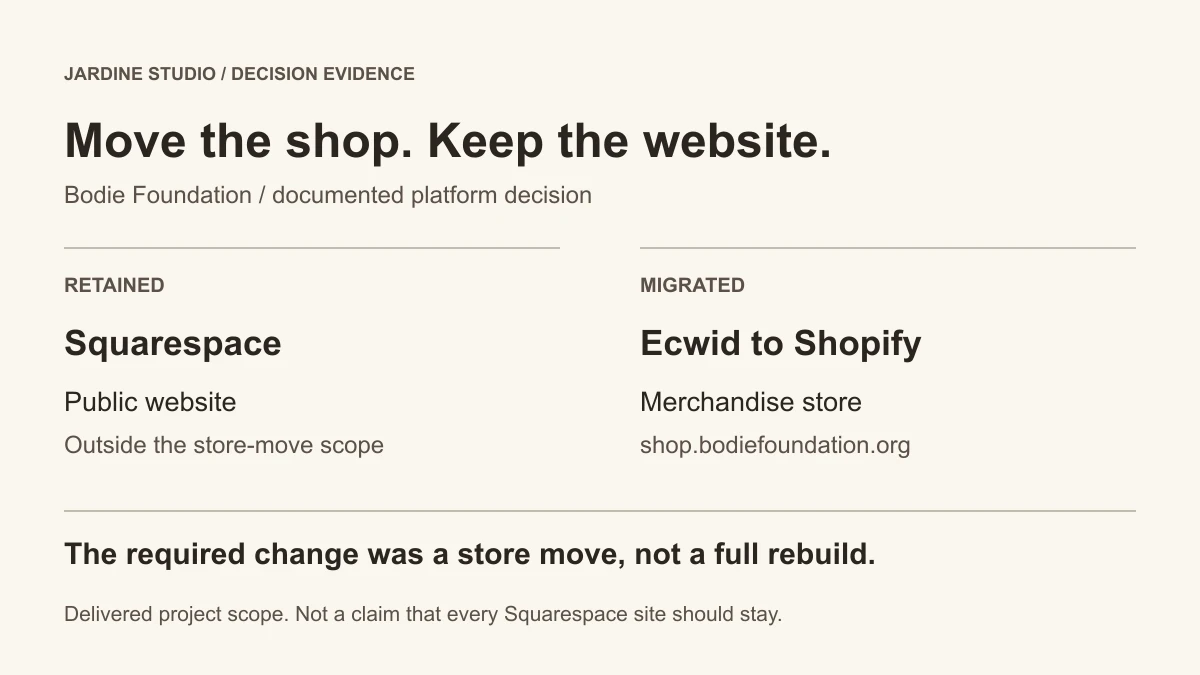
The Bodie Foundation migration case study documents the actual boundary. Jardine configured the shop address in Shopify and prepared the GoDaddy CNAME instructions. The incoming executive director completed that DNS step, and the connected shop was verified at delivery. The Squarespace public site stayed in place.
The platform diagram above separates what stayed from what moved. It offers a practical scoping test: identify the customer action that needs to change, the system that owns it, and the existing systems that can keep doing their jobs. Price that bounded intervention before assuming every platform must be replaced together.
The trade-off is that the foundation continued operating a website and a store in separate services. This case supports a narrow recommendation: keep working parts when they are outside the problem being solved. It does not compare Squarespace with a custom rebuild in a controlled test or establish a sales, SEO or revenue improvement.
Evidence: the approved Bodie Foundation delivery account and current case study. The diagram is an original summary of that recorded scope, prepared September 10, 2026. It is not a current live-domain check.
Where a custom website wins
A custom website wins when the site has to do something commercially important that should not be assembled from loosely connected page blocks, embeds, and manual handoffs.
The conversion path needs bespoke logic
A quote flow may need conditional questions, territory rules, product configuration, account data, pricing logic, document generation, or routing to a specific sales team. A booking experience may need property-timezone validation, inventory, party-size rules, rate logic, or a clean handoff to an external engine.
Those are not visual flourishes. They are part of how the business qualifies, serves, or converts a customer. A custom interface can make the workflow feel like one experience even when several systems sit behind it. The web development service explains how custom booking, CRM, intake, and application work is scoped.
Content has real structure and relationships
Consider a destination group with properties, rooms, amenities, offers, nearby experiences, policies, and seasonal packages. Or a B2B firm with industries, services, integrations, people, resources, and regional variations. These are not just pages. They are related data.
A custom content model can define each type once, connect it to other types, and reuse it across landing pages, search, maps, sales materials, feeds, and AI-assisted interfaces. Editors work with named fields and approved components instead of repeatedly rebuilding layouts.
Differentiated interaction is part of the brand
Squarespace supports custom CSS, code blocks, code injection, embeds, and third-party tools. Its own documentation also states that custom code is an advanced modification outside its normal support scope and that server-side code is not supported. That boundary matters when the design depends on application state, real-time data, complex animation, WebGL, or a coordinated interaction system rather than a decorative embed.
Custom sites can use tools such as Three.js for three-dimensional scenes, product exploration, spatial storytelling, or interactive brand moments. Awwwards' Three.js gallery shows the range of work possible. It is inspiration, not evidence that animation increases revenue. The commercial test is whether the interaction helps the right buyer understand, trust, or use the offer.
A custom website can still be easy to edit
A custom front end can have a CMS with visual previews, structured fields, reusable sections, draft states, roles, approval workflows, and scheduled publishing. “Custom” describes how the experience is designed and implemented; it does not require developers to edit every sentence.
The team might edit:
- Services, locations, properties, rooms, practitioners, resources, or products as structured records
- Shared facts once, with updates reflected everywhere those facts appear
- SEO titles, descriptions, social images, canonical choices, and indexability within approved rules
- Page sections selected from a controlled component library
- Draft content through previews before it reaches the public site
- Relationships such as which case studies support a service or which experiences belong to a property
This can be safer than a completely open visual canvas because the CMS exposes the business decisions and protects the design system. It can also be worse if the fields are designed around the developer's convenience instead of the editor's work. Editorial interviews and content modeling belong in the project scope.
Squarespace vs custom for SEO and performance
Squarespace can rank. A custom website does not receive a ranking bonus for being custom. Google says its systems evaluate overall page experience and that strong Core Web Vitals alone do not guarantee top rankings. Relevance, usefulness, authority, internal structure, crawlability, and the quality of the experience still matter.
Squarespace gives a team the standard controls needed for many sites. A custom implementation gives the team more control over rendering, routing, metadata, structured data, image delivery, scripts, redirects, caching, and content relationships. That control helps only when someone owns the specification and quality assurance.
Custom becomes strategically useful when the site needs:
- Programmatic but genuinely useful pages built from governed data
- Precise structured data tied to content types
- Multiple regional or audience journeys with controlled relationships
- Server-rendered content from several systems
- Strict performance budgets and third-party script governance
- Redirect, canonical, or indexation logic that follows complex publishing rules
Ready to move? Use the Squarespace exit inventory to collect your content and plan what happens to booking, your domain and email.
If rankings already support revenue, a rebuild also creates migration risk. The old and new URL inventory, redirect map, metadata, canonicals, structured data, analytics, internal links, and sitemap need to be validated before launch. Plan a Squarespace-to-custom migration as part of the rebuild, not after traffic falls.
Integrations are where the difference becomes expensive
Squarespace supports extensions, embedded tools, and custom browser-side code. That works well when the external service owns the full workflow. Friction appears when customer data must move reliably between systems or the website needs to make decisions before showing the next step.
Warning signs include:
- Staff re-enter form submissions into a CRM or project system
- Customers repeat information during booking, checkout, onboarding, or support
- Important rules live in staff memory because the website cannot enforce them
- Several widgets produce inconsistent design, accessibility, analytics, or mobile behavior
- Marketing cannot build a useful landing path without involving multiple vendors
- The team cannot tell where a qualified lead stopped or which content assisted it
An integration is not automatically a reason to rebuild. One reliable embed may be better than custom software. Rebuild when the combined workflow is important enough that ownership, validation, error handling, analytics, and customer experience need to be designed together.
AI makes the workflow question more important
Squarespace and other managed platforms continue adding AI-assisted setup, copy, and marketing features. A custom site can also connect language models, search, recommendation, classification, or automation services. Neither option creates a useful AI strategy by itself.
The stronger custom use cases are operational: searching approved knowledge, pre-qualifying a complex request, producing a structured draft for staff review, helping a visitor navigate a large catalog, or moving validated data into an existing workflow. These require source controls, privacy decisions, logging, human review, error handling, and a useful non-AI fallback.
For search visibility, Google's guidance is simpler than the industry hype. AI features still depend on crawlable, useful, unique content and the same foundational SEO practices. Publishing more machine-written pages is not the advantage. A clean content model, first-hand evidence, clear entities, original media, and information worth citing are.
What the business owns and what can move
The business should control its domain and have administrator access to its content and accounts regardless of platform. But ownership is not the same as portability.
Squarespace documents exports for portions of site content, products, orders, and contacts. It also documents important limits: the site's design and layout do not transfer as a reusable website, and some media and content types require separate handling. Moving platforms therefore means rebuilding the presentation, inventorying what can be exported, and manually accounting for what cannot.
Custom should reduce dependency on a closed product, not replace it with dependency on one person.
A custom build can provide source-code access and portable structured content, but only if the agreement and architecture say so. Ask who owns the repository, design files, accounts, data, credentials, domains, analytics, and deployment process. Ask what happens if the original developer disappears. Custom should reduce dependency on a closed product, not replace it with dependency on one person.
What Squarespace and a custom website cost
Squarespace usually has the lower initial and operational cost because hosting, updates, editing, and a large part of the feature set arrive together. Professional design, content, photography, SEO, commerce, scheduling, and third-party subscriptions still add to the real total.
A custom website carries discovery, content modeling, design, development, integration, quality assurance, deployment, monitoring, and ongoing improvement. Its financial case should come from the value of the solved constraint: fewer manual steps, better-qualified inquiries, a stronger booking path, reusable structured content, reduced platform workarounds, or a distinctive experience that supports the sale.
Use the custom website cost guide to understand the budget and the website cost calculator to estimate a Jardine scope. Do not compare a Squarespace subscription with a custom project quote as if they buy the same work. Compare the three-year operating model, including the people, subscriptions, maintenance, integrations, and missed opportunities attached to each choice.
Proof of what a focused custom build can do
Black Salt Room is a relevant small-business example. Jardine Studio designed and developed a custom Next.js site for the wellness studio, with booking-path decisions, reusable content, technical SEO, and a Lighthouse result of 100 across Performance, Accessibility, Best Practices, and SEO at its May 2026 launch.
That score proves what was measured on that implementation at that time. It does not prove that every custom website receives the same score, that Lighthouse guarantees rankings, or that Black Salt Room should have used Squarespace. The useful evidence is narrower: a custom implementation can combine a distinct design system, commercial path, structured content, and technical quality when those requirements are deliberately scoped and tested.
The stay, improve, or rebuild test
When it is working
- Squarespace supports the required pages and customer actions
- The team can edit it
- The maintenance model is working
When the site is the problem
- The platform is capable, but the offer, proof, content, navigation, conversion path, local visibility, or implementation is weak
- A redesign inside Squarespace may produce the needed result with less risk and cost
When the platform is the problem
- A named workflow, integration, content model, design system, performance requirement, or governance need is being compromised by the platform
- The business can fund the custom system after launch
If the answers describe cosmetic dissatisfaction, improve the Squarespace site. If they describe a valuable operating requirement, plan the custom website design around that requirement and keep the editing experience as simple as the team needs.
Before planning a platform move, test how much of the website needs to change.
Frequently asked questions
Is a custom website better than Squarespace?
How do I know if my business has outgrown Squarespace?
Can a custom website still be easy to edit?
Can I move from Squarespace without losing SEO?
Is a custom website better for SEO than Squarespace?
Do I own my Squarespace website, and what can I export?
References
The technical claims in this guide rely on first-party platform and search documentation. Award examples demonstrate possible interaction design, not guaranteed rankings, leads, or revenue.
References (6)
- Squarespace. (2026). Add custom code to your site. Squarespace Help Center. https://support.squarespace.com/hc/en-us/articles/205815928-Add-custom-code-to-your-site
- Squarespace. (2026). Import to and export from your site. Squarespace Help Center. https://support.squarespace.com/hc/en-us/articles/205814028-Import-to-and-export-from-your-site
- Google. (2026). Understanding page experience in Google Search results. Google Search Central. https://developers.google.com/search/docs/appearance/page-experience
- Google. (2026). Optimizing your website for generative AI features on Google Search. Google Search Central. https://developers.google.com/search/docs/fundamentals/ai-optimization-guide
- Vercel. (2026). Production checklist. Next.js Documentation. https://nextjs.org/docs/app/guides/production-checklist
- Awwwards. (2026). Best Three.js websites. Awwwards. https://www.awwwards.com/websites/three-js/
Has the business outgrown Squarespace, or does the current site simply need better work?
Send the current URL, the conversion path, and the workflows that feel constrained. We will tell you whether to improve the Squarespace site or plan a custom architecture. Both are valid outcomes.